Archive for December, 2011

In the Valley of the Goblins

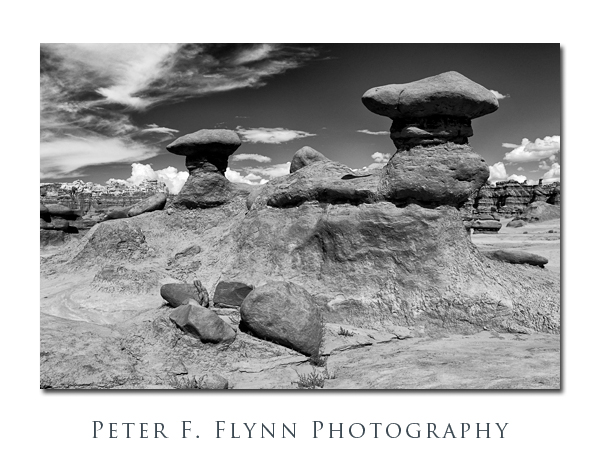
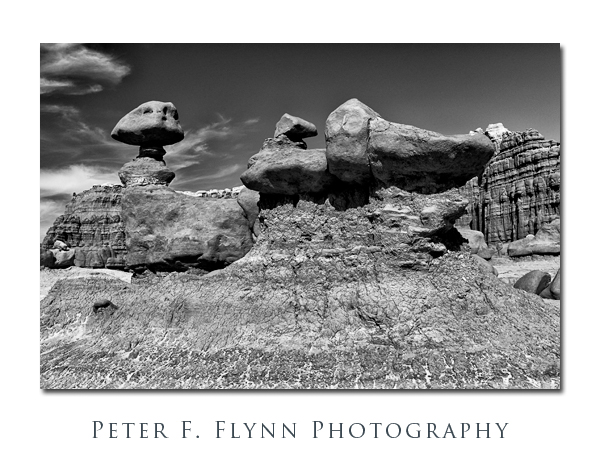
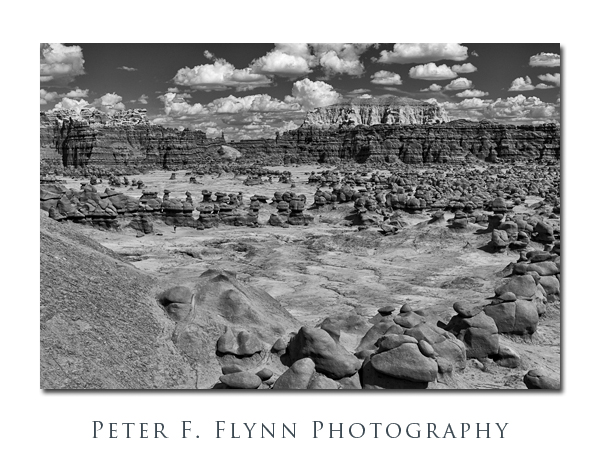
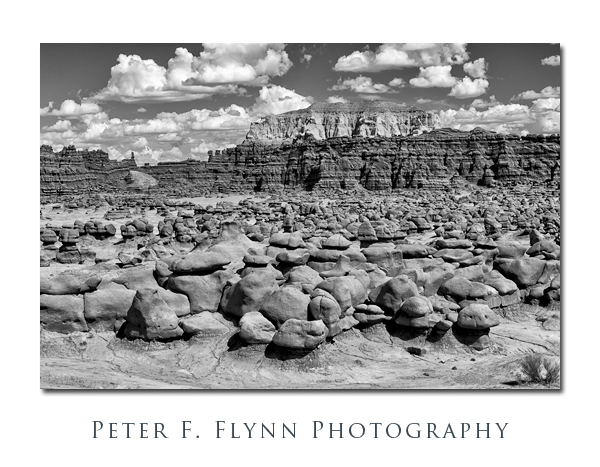
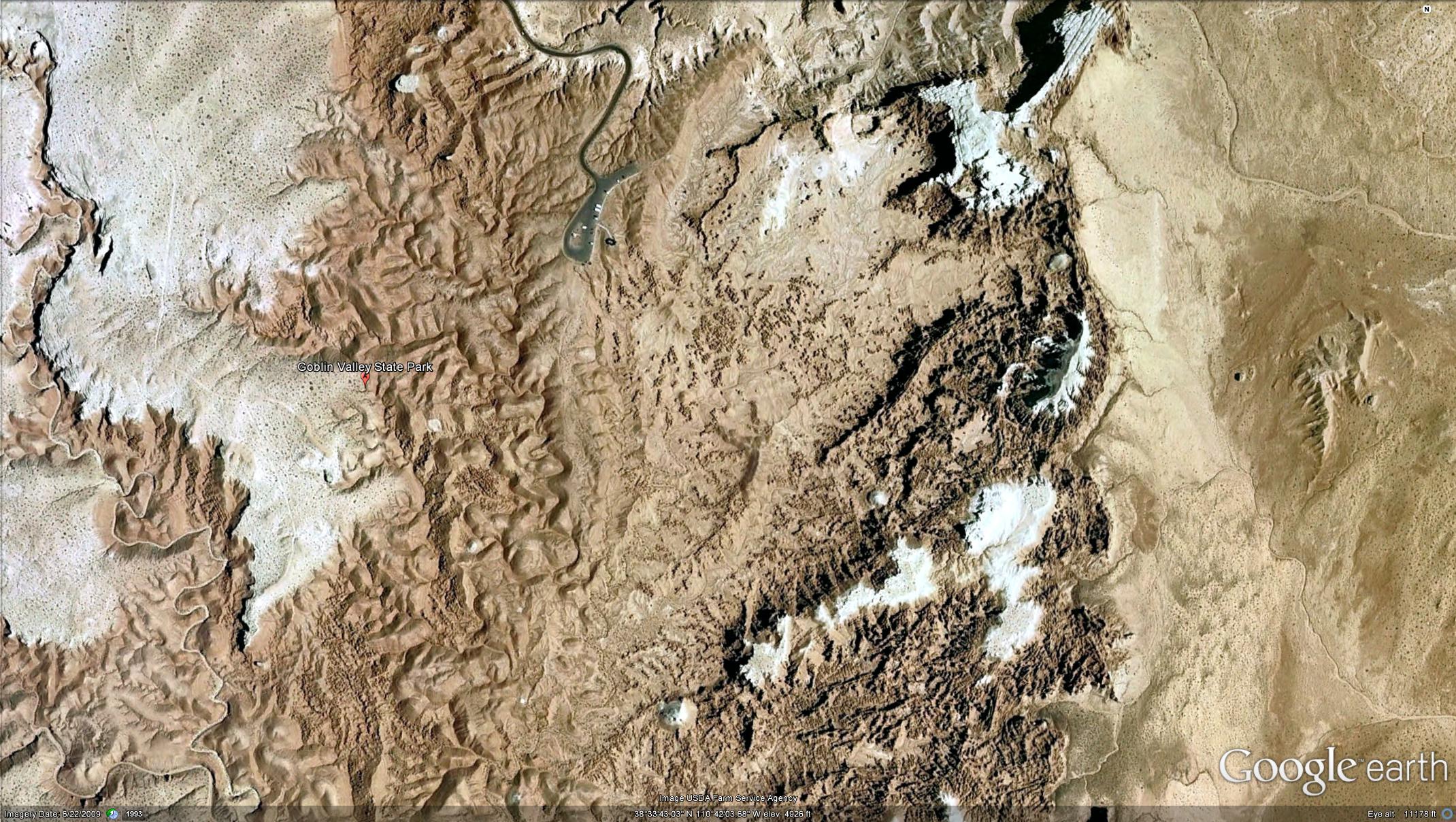
Goblin Valley, UT.  Deposition and Erosion.  For millions of years, sediments were carried by ancient streams and deposited in ancient lakes, forming what would eventually become alternating layers of sandstone, siltstone, and shale.  Later, tectonic forces caused an uplifting of the region we now know as the Colorado Plateau.  The forms we call Goblins are the result of erosion, with harder caps of sandstone lying above softer layers of siltstone and shale.
Based on the presence of Barrier Style Art nearby, we can presume that humans have been visiting the area for thousands of years.  In historical times, the area was visited by cowboys throughout much of the 19th century.  Arthur L. Chaffin, a prominent Utah engineer and entrepeneur, discovered the area with companions sometime in the 1920’s (Wikipedia ref).  By the 1950’s, the area was actively being marketed to the world.
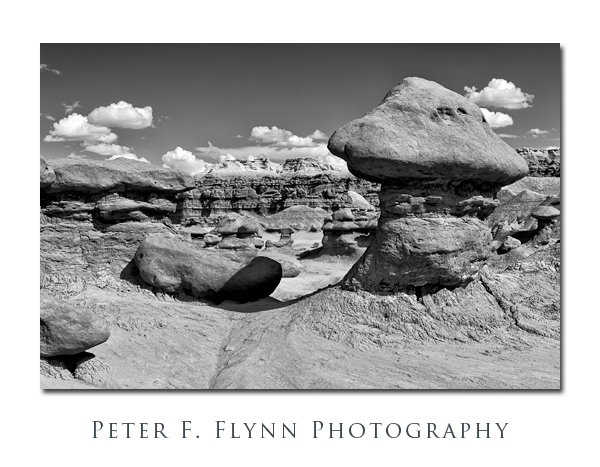
This unique geographical location was known for many years simply as Goblin Valley.  More recently, the State of Utah, or perhaps Emery County Commissioners in league with local entrepreneurs, have seemed to want to rename the area ‘The Valley of the Goblins’, as if to give the area a more posh appellation.  No matter what you call it, the small basin that contains what Mark Milligan has called the ‘wonderfully grotesque stone sculptures’, is a geological wonder not to be missed.
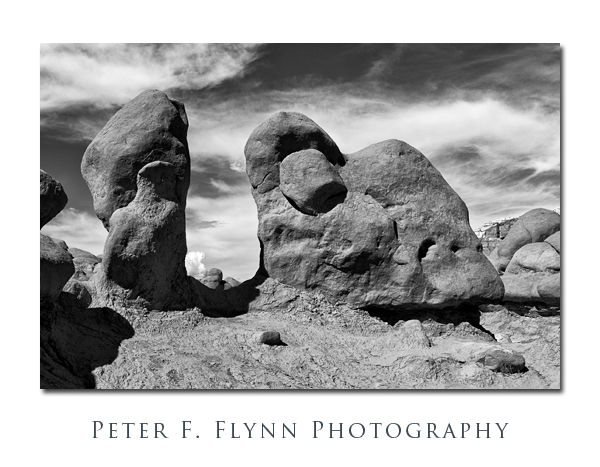
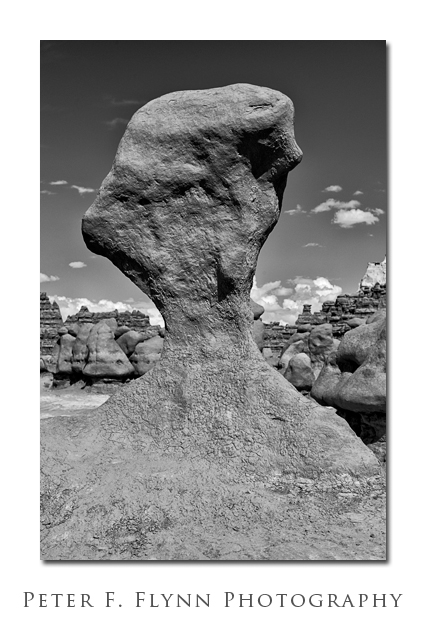
Goblin Valley may be reached from either the north or south from Utah State Route 24 (SR-24).  SR-24 runs between US Highway 70, 11 miles west of Greenriver south to Hanksville, where it then veers west through Capitol Reef and Torrey to Bicknell, and then turns northeast, eventually ending at Salinas.  From the north, travel south from the junction with US 70 about 24 miles to the junction with Temple Mountain Road.  From the south, travel north from Hanksville about 19.5 miles to the Temple Mountain Road junction.  Turn west onto Temple Mountain road and travel about 5 miles to the junction with Goblin Valley Road.  Turn south onto Goblin Valley Road and travel 6.4 miles to the entrance station (daily use fee as of 12/2011 was $7.00 per vehicle).  The valley overlook is 1.2 miles beyond the entrance station.
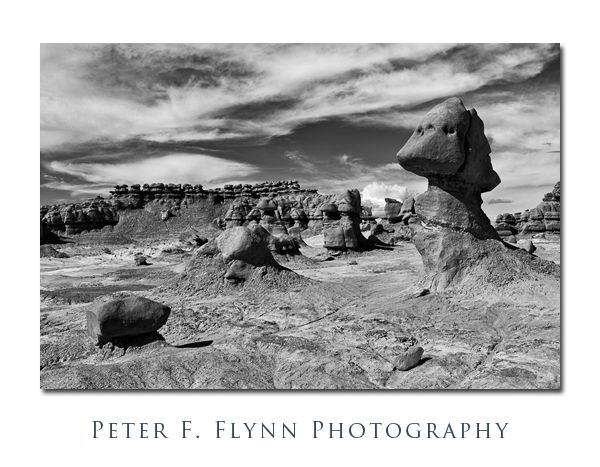
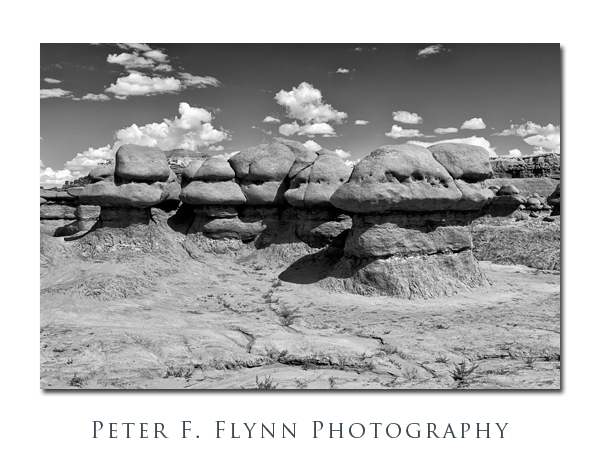
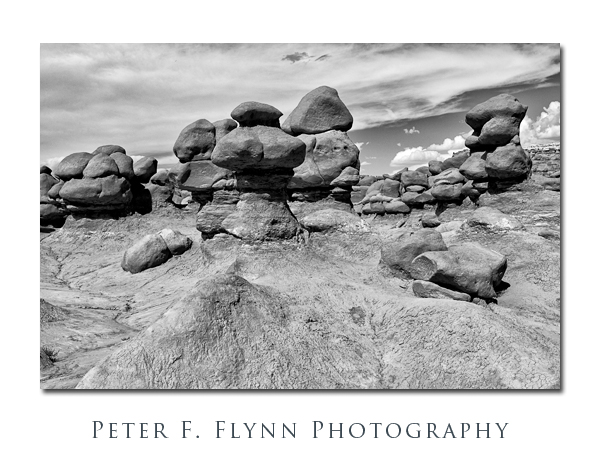
The two images directly above are representative examples of the structure of the Goblins, with the smooth rounded Entrada Sandstone caps near the center of the image on top of the softer gravely silt layer which dominates the lower right corner.  The Goblins vary considerably in height, from a about one meter up to perhaps 10 meters.

Images in this entry were recorded between 16:00 and 17:00 MDT on August 28, 2011, using the Nikon D3s and the AF-S NIKKOR 24-70mm f/2.8G ED at various focal lengths.  Exposures were f/11 and f/16, with shutter speeds of 1/125s and 1/80s respectively (+0.33 EV), ISO 200.  The images were deliberately overexposed by 0.33 EV and normalized to correct exposure in Raw conversion (ACR 6.6) to reduce noise.  Images were converted to BW using Nik Software Silver Efex Pro 2 with additional processing in Nik Color Efex Pro 4.

A Google Earth image of Goblin Valley is shown below:
An excellent guide to the geology of Goblin Valley written by Mark Milligan is available online:
Copyright 2011 Peter F. Flynn.  No usage permitted without prior written consent. All rights reserved.
A Trickster in Hayden Valley

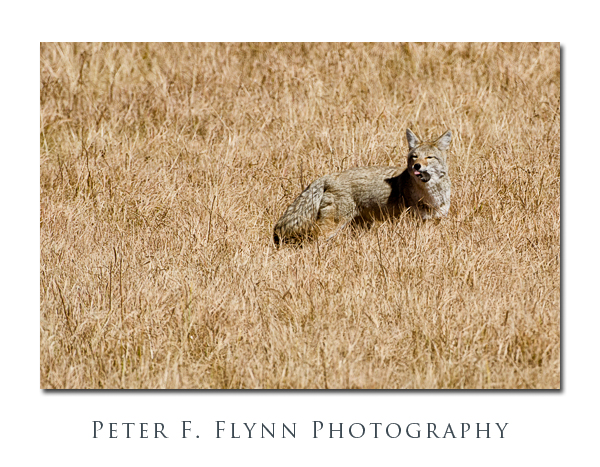
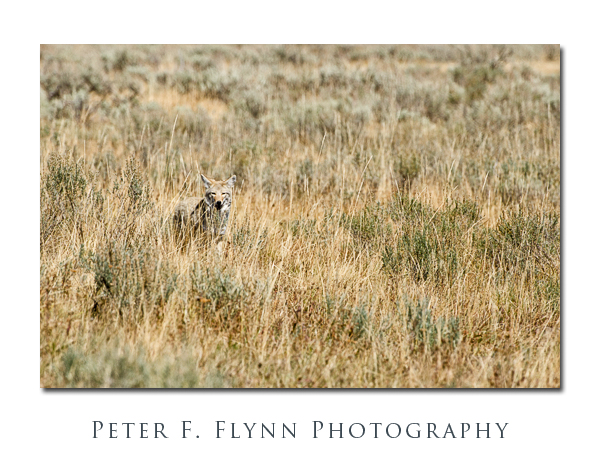
A number of native American Indian cultures have identified the coyote as The Trickster.  A trickster is a sort of cunning character who makes use of subterfuge, i.e., illusion, misdirection, etc., usually with the goal of committing some sort of fraud.  Accepting for the sake of discussion that it is valid to anthropomorphize wild animals, then to my eye, the suggestion that the coyote is a trickster is an apt judgement – they always seem to be up to something slightly sketchy.

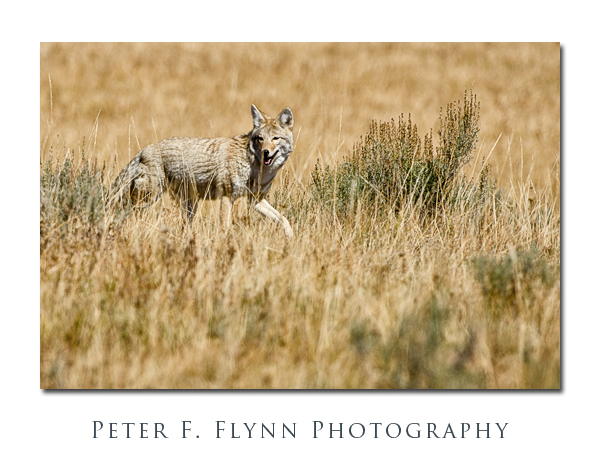
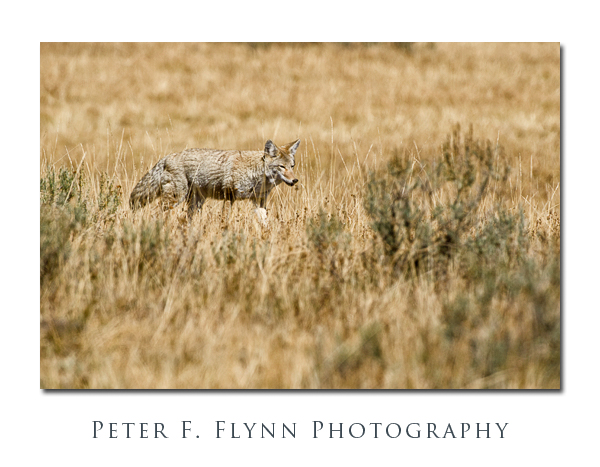
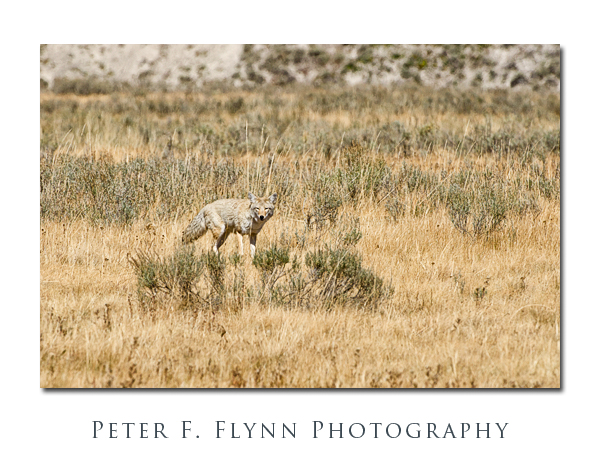
This trickster nature is apparent in the way the coyote carries itself, which a bit shifty, moving through the sagebrush or tall grass like a pickpocket working the crowds at a carnival.  The short, persistent gait of the coyote is distinct from that of the wolf, which has longer legs and a resulting much more open stride. Parenthetically, although there are several ways to distinguish wolf and coyote, the difference in gait is the thing that I notice first.

And of course that Coyote face, which is so full of mischief…  Is it my imagination, or are these guys always squinting?

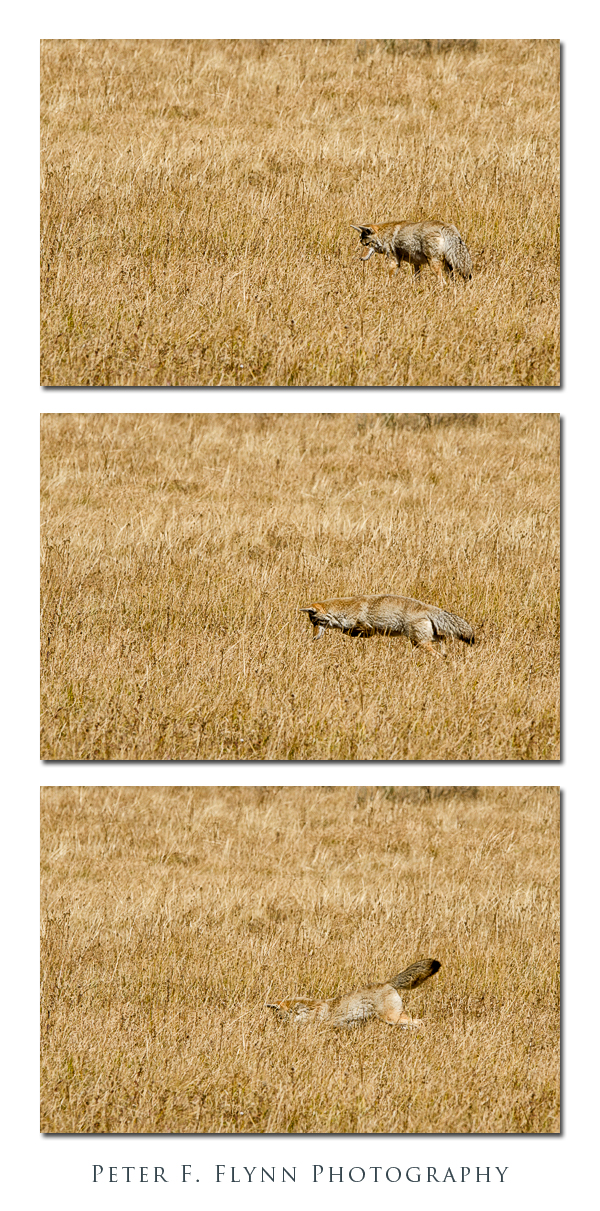
Perhaps it is their opportunistical feeding behavior that impresses me most.  Unlike wolves that hunt large prey in organized hierarchical groups, the coyote bounces around solo or in pairs, and will eat anything it can.  Voles seem to be a staple food of the coyote.  We have watched coyotes consume half a dozen voles in a single episode – in fact I cannot recall seeing coyotes eat anything but voles!

Leaving out the anthropomorphic judgements, there is no doubt but that the coyote is a highly adaptable and highly successful creature.  The Trickster even adapts relatively well to urbanization.  Although it is most common to observe coyotes hunting solo or in pairs, within Yellowstone, coyotes live in packs of up to seven individuals.

Prior to the reintroduction of wolves into Yellowstone in 1995, the coyote population grew to relatively large numbers due to the lack of a major predator.  In the years immediately following restoration of a stable wolf population, coyote numbers fell 30-50%, but the population has now stabilized.  The Yellowstone Resource and Issue 2011 report* does not provide a specific population esitmate for coyotes, and lists the population only as ‘numerous but unknown’.

Images in this entry were recorded in the Hayden Valley, Yellowstone National Park, at around 13:30 MDT on September 21, 2011, using the Nikon D7000 and the AF-S NIKKOR 200-400mm f/4G ED VR II  at 400mm (600 mm FX equivalent).  Exposures were made at f/5.6, f/7.0, and f/8.0 with shutters speeds at either 1/1000s or 1/1250s.  Tripod setup was the Gizto GT5541LS and the Wimberly WH-200 gimbel head.

*The Yellowstone Resource and Issues 2011 report is issued annually, and is produced by the Division of Intepretation, Yellowstone National Park, Mammoth Hot Springs, WY.  The report is available at the park bookstores and online at the followstone site:

http://www.nps.gov/yell/planyourvisit/resourceandissues.htm

Copyright 2011 Peter F. Flynn.  No usage permitted without prior written consent. All rights reserved.
Meredith’s Garden

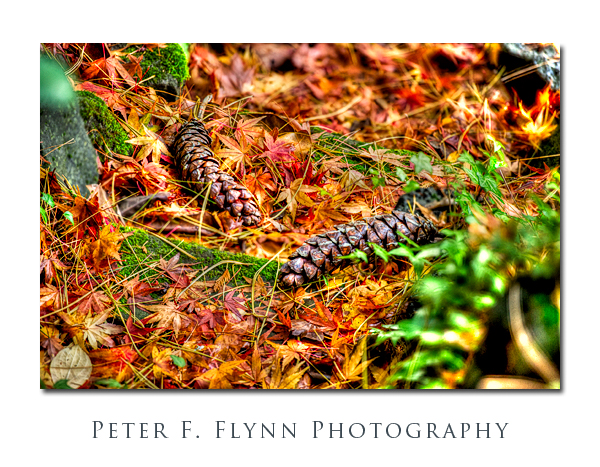
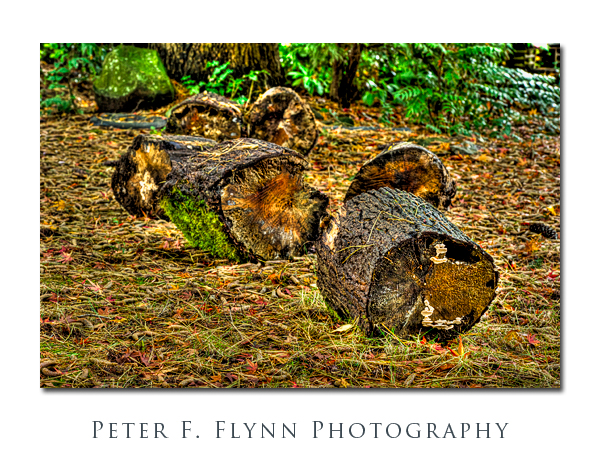
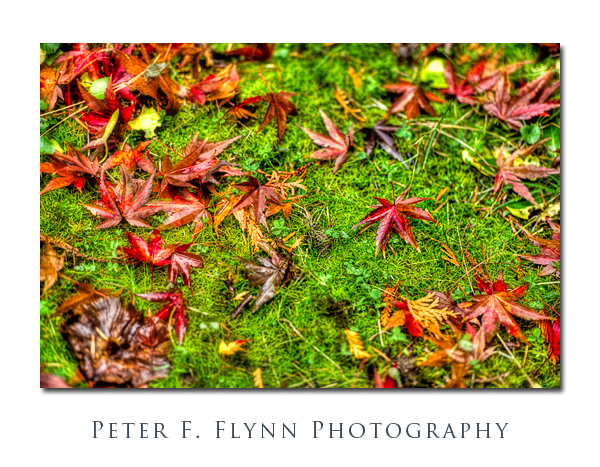
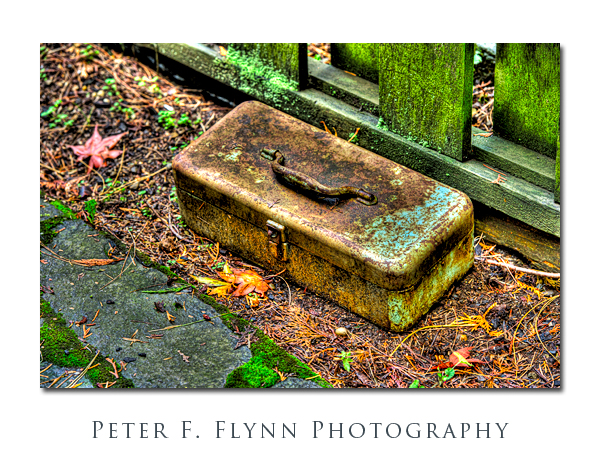
Hidden amongst tall firs a few miles east of the Willamette River, there is a secret garden.  Meredith’s garden.  From the outside, it’s anyplace SE PDX, but inside, well inside, it’s a magic world.

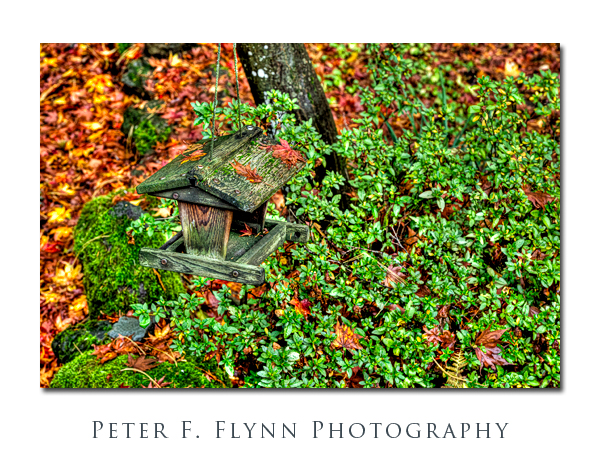
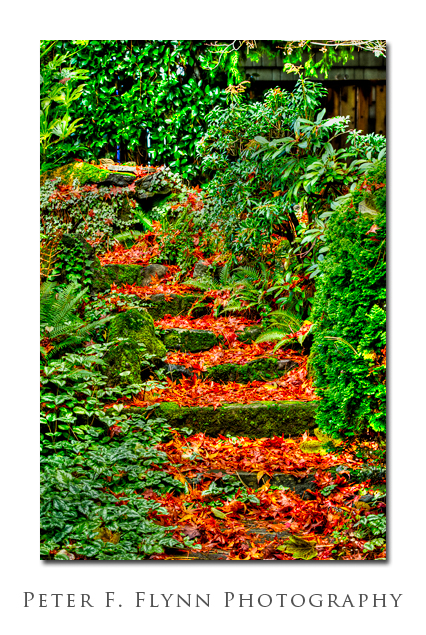
As you can see, ‘magic’ is pretty much the same thing as trees and bushes, moss and leaves, and wet, plenty of wet.

The images above were recorded at around 12:00 PST on November 25, 2011, using the Nikon D3s and the AF-S NIKKOR 70-20mm f/2.8G ED at various focal lengths.  All of the images in this entry were converted to HDR using Photomatix Pro 4.1.4: Both single-shot and bracketed input images were used.  I currently favor Photomatix over HDR Efex Pro.  Both are excellent software packages, and although the Nik-ware provides a huge array of default styles, only a few of them are actually very useful.  By contrast, Photomatix seems to produce images with greater depth and pleasing contrast and color saturation with little effort.  The recent addition of real-time hints for parameter functions in Photomatix is very useful.  Additional contrast and saturation, as well as increased local/micro-contrast were applied using Kin Viveza 2 and Nik Color Efex Pro 4.

Copyright 2011 Peter F. Flynn.  No usage permitted without prior written consent. All rights reserved.