Archive for the ‘Uncategorized’ Category

I’ll See You On the Dark Side of the Moon

White light passing through a slit or from air into a prism generates a spectrum (rainbow).  This is due to the fact that different component frequencies/wavelengths of the light refract (bend) by different amounts as they cross the boundary between the rarefied phase (air) and the condensed phase (glass or water).  The phenomenon is known as the index of refraction.  The technical origin for this effect is that the phase velocity (speed) of light in a condensed medium depends on its wavelength/frequency.

Remember the album cover for Dark Side of the Moon?  CD, I meant CD case!  You can easily find the image on the net.  White light enters the prism from the left and a spectrum of light exits from the left.  From top to bottom the colors are  red, orange, yellow, green, blue, and violet.    Do you recall the mnemonic for the colors of the rainbow?
Spectrum

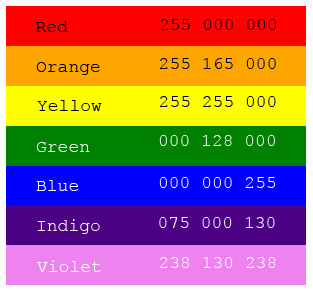
Spectrum with common synonyms and RGB decimal equivalents as defined in the HTML/CSS standard

Roy G. Biv : Red, orange, yellow, green, blue, indigo, and violet, which is one more than on the Pink Floyd album cover.  Why the difference?  Well Isaac Newton made up this color series you see, and being a law-and-order sort of fellow he imagined that the light spectrum might be best understood by analogy to a musical (octave) scale.  To make this work out he artificially added a seventh designation, indigo, between blue and violet.  Of course visible light can be anywhere between red and violet.  By the way, almost nobody can distinguish indigo in rainbows or in other diffraction experiments.  Red light has the longest wavelength at 750-620 nm; orange ranges from 620-590 nm; yellow is narrow and between 590 nm and 570 nm; green is from 570-495 nm; blue is 495-450 nm; and violet is 450-380 nm. Longer wavelengths are known as infrared (more on this in a future entry) and shorter wavelengths are ultraviolet.

Notice that although the color spectrum represents a continuous variation from longer to shorter wavelengths, the decimal specification from the individual red, green, and blue channels is less than intuitive.   Most of you already know that in this  RGB system values can range from 0 through 255 inclusive, but why should the color red be defined as the full range of the R channel whereas the color green is only half of the maximal value?   Is it at all obvious that violet should contain a half-maximal contribution from the green channel?  In future entries we’ll return to the quantification and analysis of color, both as a diagnostic tool and as a method for maximizing the impact of the images.  We’ll also consider another color space known as the Lab color space that provides a more intuitive connection between qualitative and quantitative interpretations of color.

By the way, the title of the song you are trying to recall is Brain Damage (hee hee!) .  Now let’s try to keep the loonies on the path.
Chromatic Aberration

Chromatic aberration (CA) consists of two effects.  One manifestation of CA is the residual uncompensated variations in the plane of focus for light impinging on the film plane or sensor. Camera lenses are made up of a series of individual glass elements – a major design consideration is adding compensating elements to cancel out the natural dispersion (spreading out) of light as it passes through the lens elements.  Reducing CA must be balanced against the other design requirements that include brightness, edge-to-edge sharpness, contrast, and bokeh.  There is really no remedy for this sort of lens imperfection.

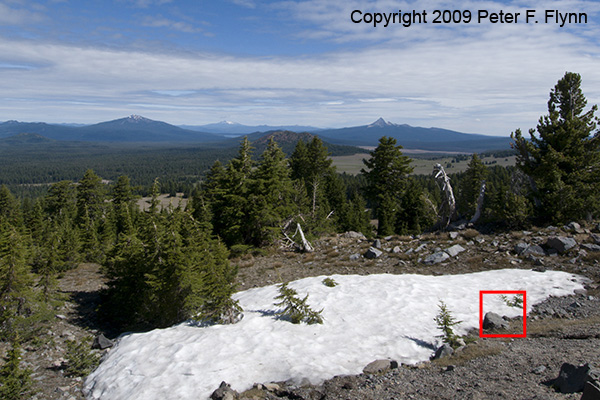
Red Box Highlight

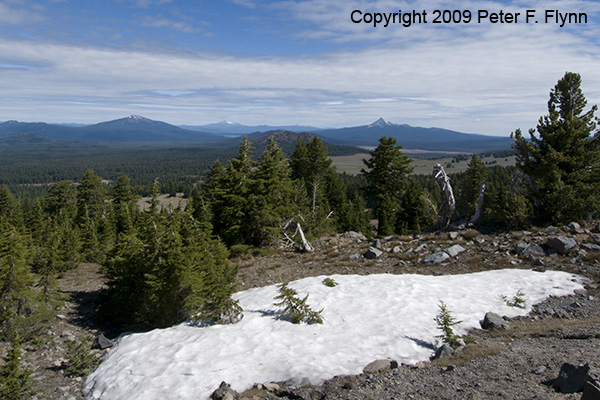
Consider the image above; which was originally posted in the February 6th entry.  The limited resolution and size of the image prevents you from determining whether there is any CA present.  We’ll expand the image and focus on the region enclosed with the red square as shown below.

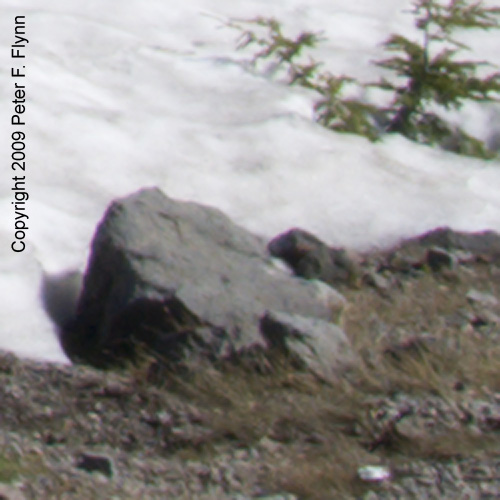
Purple Fringe!

Notice the purple fringe around the left side of the rock at the margin between the rock and the snow.  That’s your classic example of CA ladies and gentlemen.  Note that you can also see the effect around a smaller rock near the lower right, and in fact amongst all of the rocks in the lower section of the crop.

Elements of the Workflow – Overview

_00b0313_copyright

I’m always thinking about workflow.  Generating an adaptive and efficient system for processing images.  You’d think with all the books and videos on image processing that this would be easy.  But it’s exactly that there is such a vast variety of images and processing strategies that makes settling on a system the grand challenge.  A constant stream of new tools further complicates matters.

Let’s start with the image above.  Not a world beater by any means, but a pleasant enough shot looking north from Crater Lake towards the southern Oregon cascades on July 29th of last year.  At least we have obeyed the rule of thirds.  The image was made using the Nikon D300 with the AF-S DX Zoom-Nikkor 12-24mm f/4G IF-ED lens at 12mm.  I’m a big fan of both camera and lens.  The exposure was f/16 at 1/250s with an ISO of 200.

I specifically chose this image because it includes many of the elements that challenge my workflow.  Are the colors correct?  The sky is basically blue, but is it really right?  I believe it’s probably too cyan.  Are the trees green?  Maybe a bit too yellow.  Are the snow and rocks neutral?  How can we verify that the colors are correct?  Are there any other problems that might keep this image from being a good as it could be?

Images are first evaluated for artistical potential.  Things that don’t make the grade don’t get processed further.  The initial elements of my current workflow focus on inspecting the image for any defects in the image, which most commonly consist of artifacts due to dust on the sensor (an uncommon occurrence due to the dust reduction system) and color defects of one kind or another.  Color defects include errors in white balance, the influence of reflected light, and chromatic aberration.    The next few entries will cover several workflow issues using this image as an example.