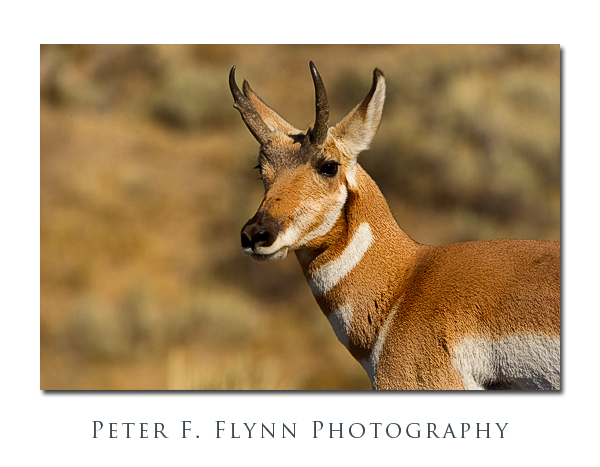
Pronghorn at the Chokecherry Browse

The area along the Northeast Entrance Road in the YNP between the Yellowstone River (west) and Lamar River (east) is one of the most lovely parts of the park.  There are a gathering of small ponds amidst a most curious boulder field south of the road that provides a strange and wonderful bit of scenery.  The imposing bulk of Specimen Ridge dominates the southern view.
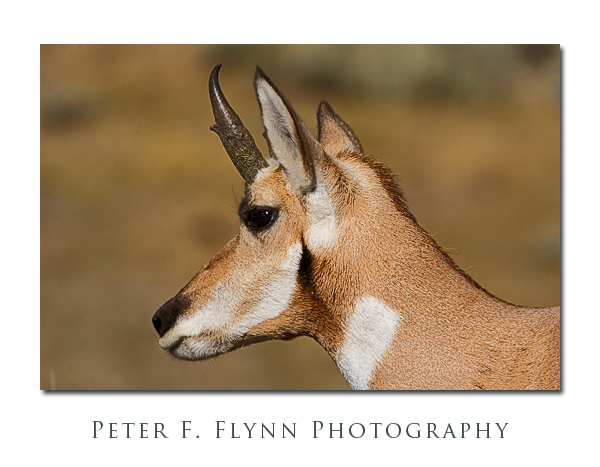
Here too, we often find animals, both north of the road to Slough Creek, and south of the road up to Specimen Ridge.  We’ve seen specimens of just about every large animal that inhabit the park here: Bison, Black Bear, Griz, Pronghorn, even Wolves.  On a recent drive through we found this young Pronghorn buck all alone working a beautiful little section of Chokecherry browse.  This is a young buck, probably less than three years old.
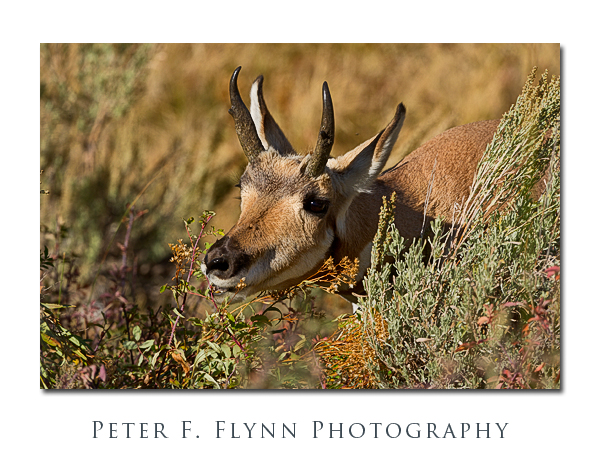
A bit of a mystery here…  Chokecherry is toxic to ruminants, and yet it was clear that the Pronghorn was eating the new growth from these plants (in addition to grass and other vegetation).  There is of course the possibility that these plants have been misidentified.
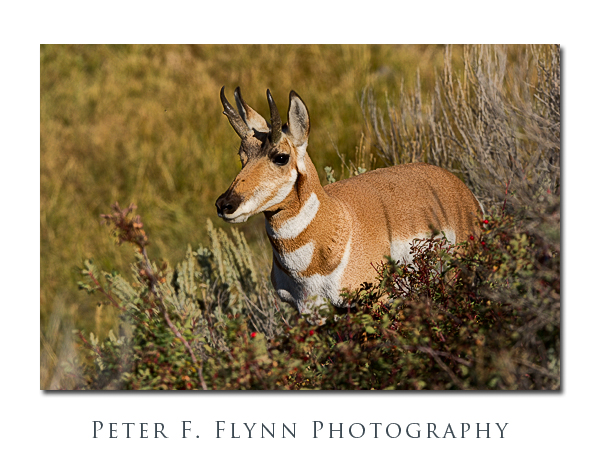
An elder gent observed that ‘Too bad it’s not a trophy buck.’  True, but you rarely get this close – in the rut, I wouldn’t advise even an attempt to get this close to a mature buck.
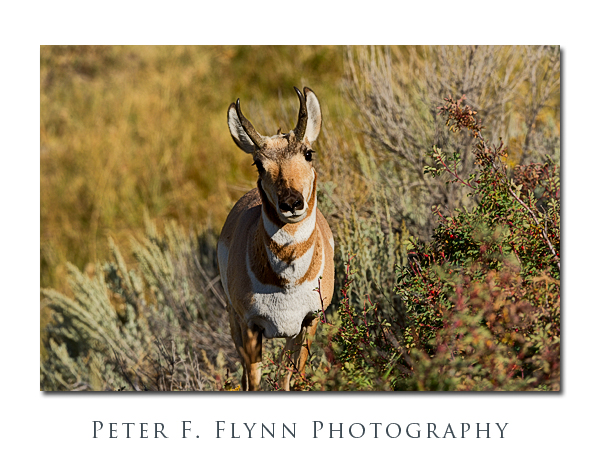
Images in this entry were recorded at around 17:30 MDT on September 21, 2011, using the Nikon D3s, and the AF-S NIKKOR 200-400mm f/4G ED VR II lens at between 300mm and 400mm.  Exposure was f/8.0 and 1/1250 to 1/1600, ISO 800.  Exposures were made at +0.3 EV and normalized using ACR 6.5.  Capture sharpening was applied using Photokit Capture Sharpener 2.  Images were processed using Nik Viveza 2 and Color Efex Pro 3.

 Copyright 2011 Peter F. Flynn.  No usage permitted without prior written consent. All rights reserved.
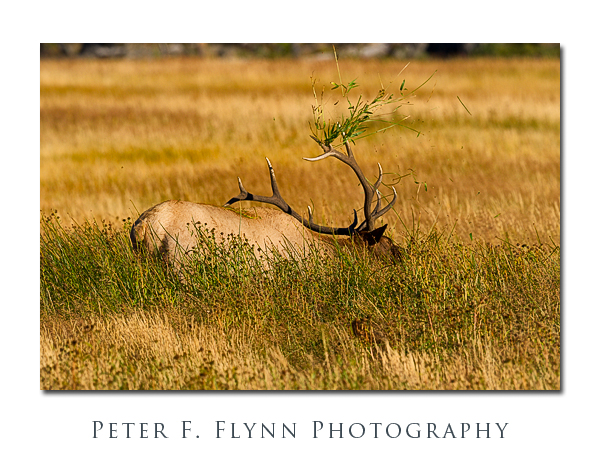
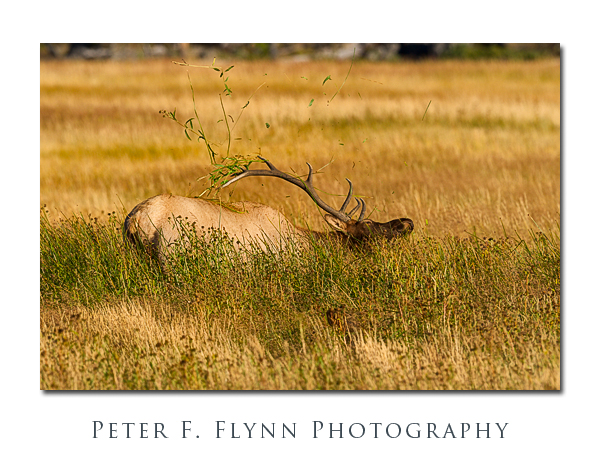
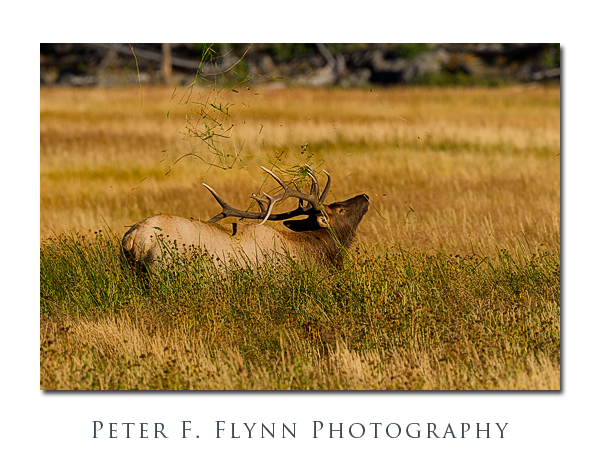
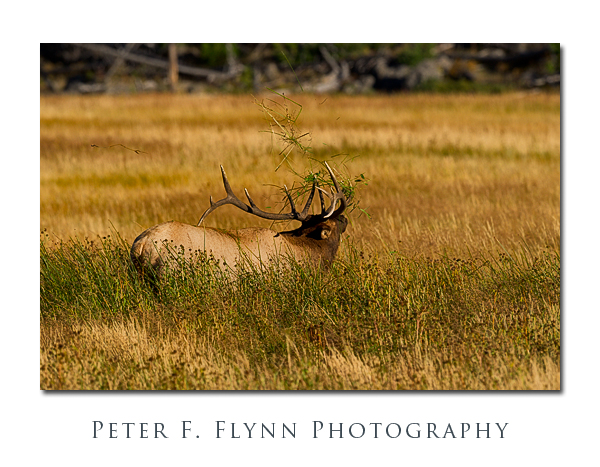
Elk Rut at Madison Junction

Each fall, hundreds of photographers swarm Yellowstone National Park in an effort to make images of bull Elk.  By mid-September the rut is in full swing, and this amazing event can best be viewed from Mammoth Hot Springs near the northern entrance of the park, the Lamar Valley in the north central section of the park, and at Madison Junction near the west entrance.

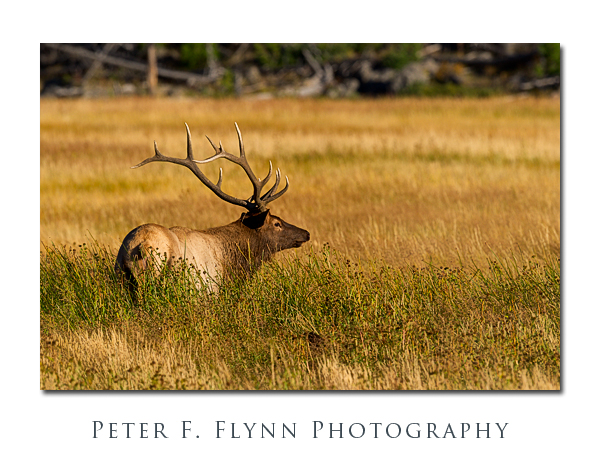
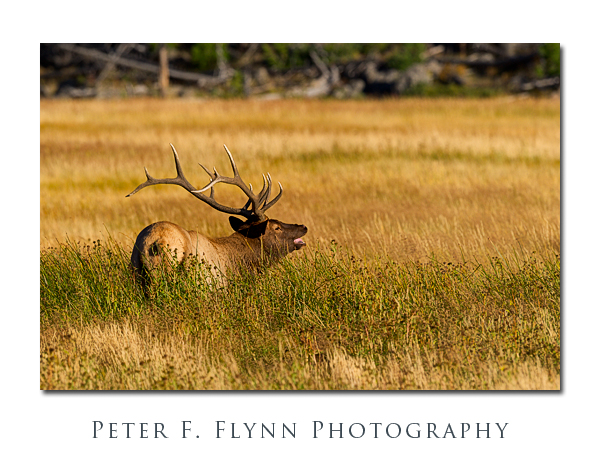
I am naming the behavior documented in this entry as ‘scything’.  This a common rut-antic in which the bull slashes antlers rapidly back and forth through rough greenery, launching bits and pieces of cut grass through the air.  One must guess that this is instinctive behavior designed to sharpen the edges of the rack.  Regardless, many blades of tall grass are sacrificed in the effort.

The flats adjacent to the Madison River near the Junction provide a startlingly beautiful location from which to observe the rut.  The West Entrance Road runs very close to the Madison River here, and there are many pull-outs along the roadway that provide excellent vantage points.  The bulk of the activity occurs between Madison Junction and Seven Mile Bridge, which is the first bridge over the Madison River along the road heading westward from Madison Junction.  This is only about a six mile stretch, yet during the rut, as many as half a dozen bulls can be competing here.

Elk are crepuscular beasties, so naturally the best opportunities to observe them will be in the early morning and late afternoon.  I prefer to visit them in the afternoon and early evening, at that time the setting sun produces a most pleasing warm light.  The tall grass that lines the floor of the Madison Valley glows intensely at this time, which can produce precisely the sort of contrast one is hoping for in wildlife photography.

The pull-outs provide generally very nice spots from which to shoot, however the road runs close to the southern edge of the wall of Madison Canyon, which means that the shooting-angle can run uncomfortably close to the sun.  In addition, the Elk often congregate near the Madison River, which likewise tends to place animals between the photographer and the sun.  In spite of these challenges, unparalleled opportunities for image-making exist here.

Images in this entry were recorded at around 18:00 MDT on September 20, 2011, using the Nikon D3s and the AF-S NIKKOR 600mm f/4G ED VR lens.  Exposure was in the range of f/5.6 to f/8.0 at shutter speeds from 1/2000s to 1/1000s, ISO 800.  Images were processed in ACR 6.4.1, with additional work conducted in Nik Viveza 2 and Nik Color Efex Pro3.

Madison Junction derives its name from the confluence of the Gibbon River and the Firehole Rivers, which meet here to form the Madison River.  Although the Madison here is a modest stream, it flows westward and northward to meet the Jefferson River at Three Forks, MT, to form the Missouri River.

Historically, Madison Junction is the location at which, in 1870, members of the Washburn-Langford-Doane Expedition met to hatch the notion that the area was too important to be owned by private individuals.  A small placard at the Madison Junction Information Station commemorates this key event in National Park history.

Copyright 2011 Peter F. Flynn.  No usage permitted without prior written consent. All rights reserved.
Interiors in HDR: Timberline Lodge

One of the most effective ways to record interiors is to employ high dynamic range images (HDR).  The approach circumvents the major impediment to indoor captures, e.g., flash, that is always challenging, and frequently simply not an option.  In this entry I will submit a few simple examples of the approach in one of my favorite locations.

Timberline Lodge, parked on the southern buttress at the very foot of Mt. Hood, Oregon, is a unique mountain location.  Built in the late 1930’s as a Work Projects Administration endeavor, the Lodge is a living museum, containing excellent examples of timeless alpine craftsmanship.  The style has been called by some, Oregon Gothic.  I like this characterization.  This stonework is found around the greater Portland area, and is unique in all of the world:  A style raw and heavy, as if built one time, for all time.

Images in this entry were recorded on the evenings of August 19 and 20, 2011, using the NIKON D3s, AF-S NIKKOR 16-35mm f/4G ED VR, and the AF-S NIKKOR 24-70mm f/2.8G ED.  Exposure were made at f/8.0 or f/11.0 with shutter speed bracketed to generate exposures at -2.0 EV, 0 EV, and +2.0 EV.  The two images above were recorded from the third floor of the Lodge.  The next three images were made on the second floor, and the final three images were made on the ground floor.

The Lodge is open to the public, and can be visited year-round.  The Lodge is a working inn as well, with a wide variety of rooms, some of the suites quite large,  a formal restaurant (Cascade Dining Room) and two bars (Ram’s Head and Blue Ox).  It is a joy to wander around the place, as there are many alcoves and secret places, back staircases (formally closed to the public, whatever) lead to all sorts of interesting rooms…

Those of you who have visited the Lodge will wonder why there are no people in the images.  During the day, at least during summer, the Lodge is mobbed and shooting an HDR sequence is virtually impossible.  One of the big benefits for photographers of staying at the Lodge is that you can shoot in the late evening and early morning hours pretty much unobstructed – this is a critical advantage for HDR imaging.

HDR images were generated based on the bracketed captures using Nik HDR Efex Pro, with additional image enhancement using Nik Vivaz 2 and Nik Color Efex Pro 3.0.  A dedicated follow-up entry on HDR generation and processing will appear ASAP.

For additional information on the history of Timberline Lodge I recommend the Friends of Timberline site: Find it here.

Copyright 2011 Peter F. Flynn.  No usage permitted without prior written consent. All rights reserved.