Fall Color Along the Mount Nebo Scenic Byway

There are many excellent locations to view fall color in Utah.  Although many of the best spots are within a short drive of Salt Lake City, I usually manage to miss the chance to photograph the event.  Not this year though!  In this entry I chart a visit to the Mount Nebo Scenic Byway, which is known around Utah simply as The Nebo Loop.  The Byway is a 35 mile stretch of road that parallels I15 (thus Byway) and links Payson to the north with Utah SR 132 about 5 miles east of Nephi.
Access from the north may be gained by traveling from Payson, south along Main Street to 800 South.  Turn east on 800 South and continue a couple of blocks, passing the LDS Seminary to the north to South Canyon Road.  Turn southeast on to South Canyon Road, and follow the road about 0.75 miles to the junction of 600 East and the Nebo Loop Road.  Access from the south may be gained by traveling east from Nephi along Utah SR 132 for about 4.8 miles to the junction of SR-132 and the Salt Creek Canyon Road.  Turn north on to the Salt Creek Canyon Road and travel northeasterly for 3.3 miles to the junction with the Nebo Loop Road.
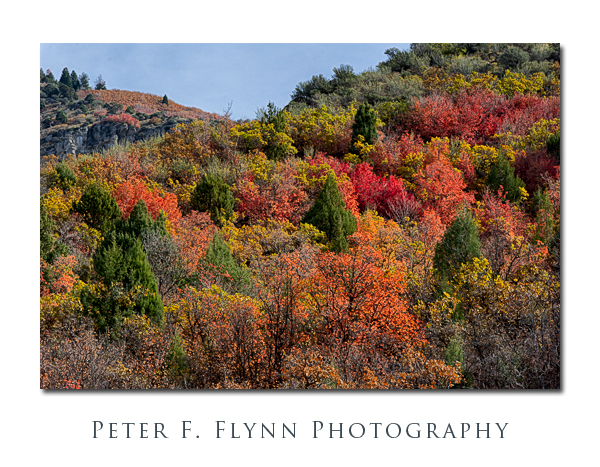
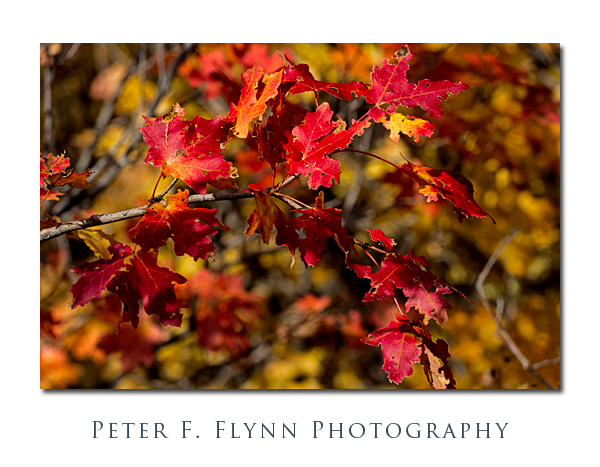
The Nebo loop Road straddles the eastern boundary of the Mount Nebo Wilderness in the Uinta National Forest.  There are abundant opportunities here for outdoor adventures, including camping.  Although the Byway is mostly curved, and generally a bit narrow, the road is paved and well maintained.
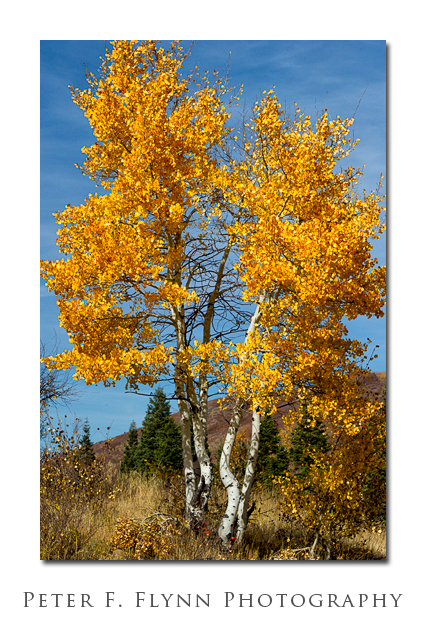
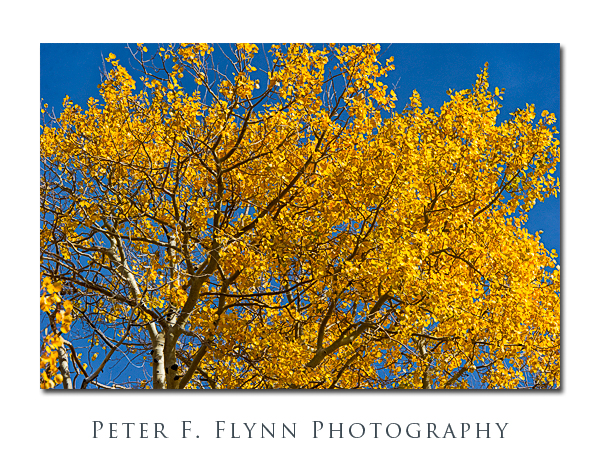
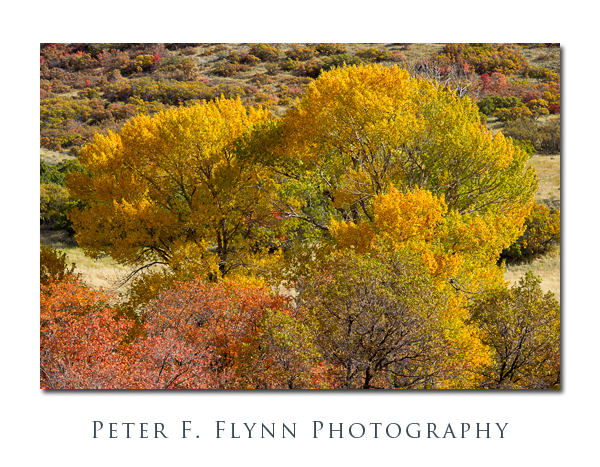
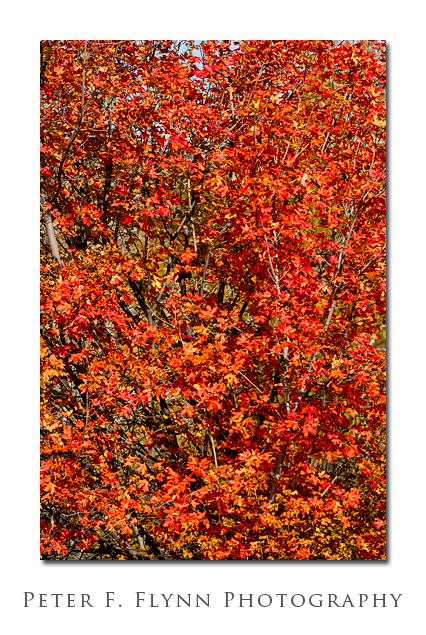
The fall color here is dominated by the red and orange hues of the abundant maple trees.  Cottonwood trees and aspens also make a an important contribution as is evident in the images shown above.  The color, as of October 22, was intense, and the leaves were just beginning to fall.

On this visit I traveled to the junction of the Nebo Loop Road and the Santaquin Canyon Road, then followed the latter down to a point just south of Santaquin city.
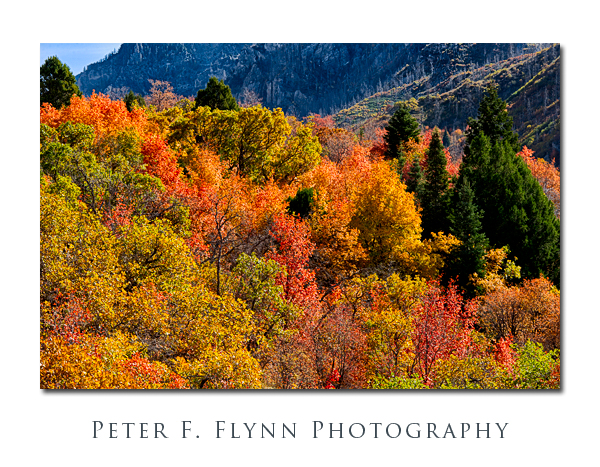
Images in this entry were recorded from late morning through late afternoon on October 22, 2011, using the Nikon D3s and the AF-S NIKKOR 24-70mm f/2.8G ED and AF-S NIKKOR 70-200mm f/2.8G ED VR II lens.  Images were processed using Adobe Photoshop CS5 with PhotoKit Sharpener and Nik plugins.

If you’d like some music to go with your review of this entry, I can recommend the lovely rendition of Jeremy Lindsay’s Scattered Leaves by The Be Good Tanyas – the live version, linked HERE, is simply awesome.

Copyright 2011 Peter F. Flynn.  No usage permitted without prior written consent. All rights reserved.
Red Hartebeest 1, Evan van der Spuy 0

There is this awesome video…

Evan van der Spuy vs Red Hartebeest

The bit has gotten tons of play here in Utah as ‘Antelope attacks cyclist’.  The animal in the video is a Red Hartebeest, which is in fact a species of true Antelope, genus Alcelaphus.  These guys can get pretty big, up to about 400 lb.  The cyclist is Evan van der Spuy, a rider for Team Jeep South Africa.  The largest cyclists weigh in at maybe 175 lb.

For better or worse, when Utahns hear the word ‘Antelope’, they think of their Pronghorns.  As I’ve mentioned in previous entries, Pronghorns are not from the Family Bovidae, but rather the last remaining member of the Family Antilocapridae – this is technical way of saying that Pronghorns are much more like Giraffes than true Antelope.

We’ve spent a lot of time with Pronghorns, a lot.  We’ve seen them in all sorts of situations, under attack from Coyotes and Wolves, in the rut (but never in a horn-to-horn conflict), even got a very rare glimpse of newborn Pronghorns.  They are beautiful, gentle, critters, whose main enjoyment in life seems to be to effortlessly dust off the odd goofy Canid that attempts a run at the herd.  A trophy Pronghorn buck might get to 150 lb.  The big clue in the video is that Antilocapra americana do not jump, as in, at all.  But the idea that a Pronghorn attacked a cyclist is too funny, and thus the myth is born.

 Copyright 2011 Peter F. Flynn.  No usage permitted without prior written consent. All rights reserved.
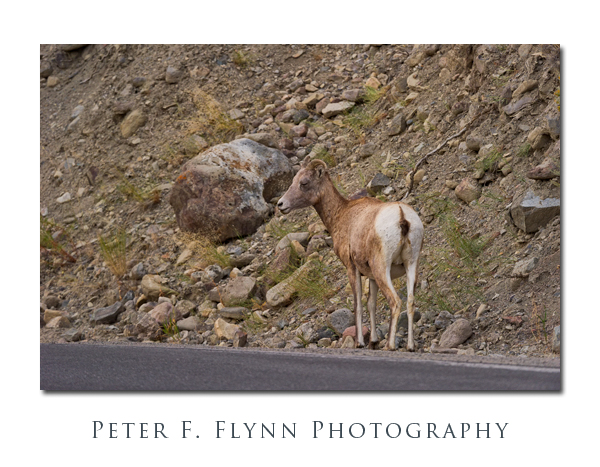
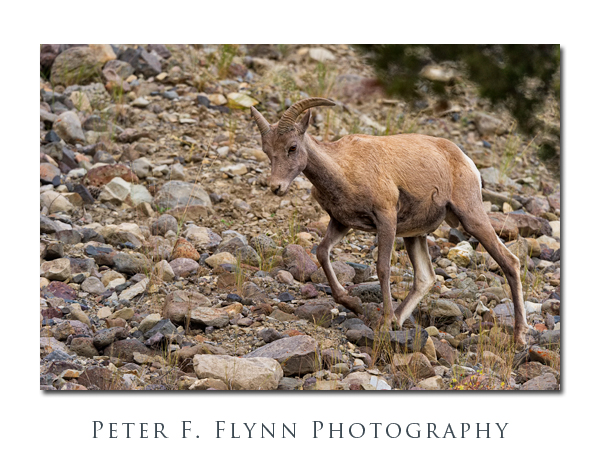
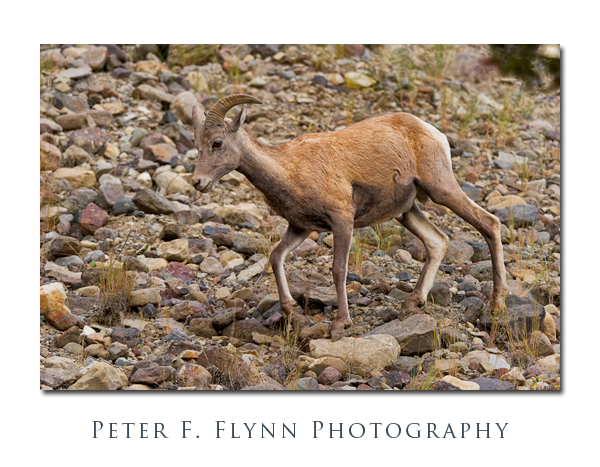
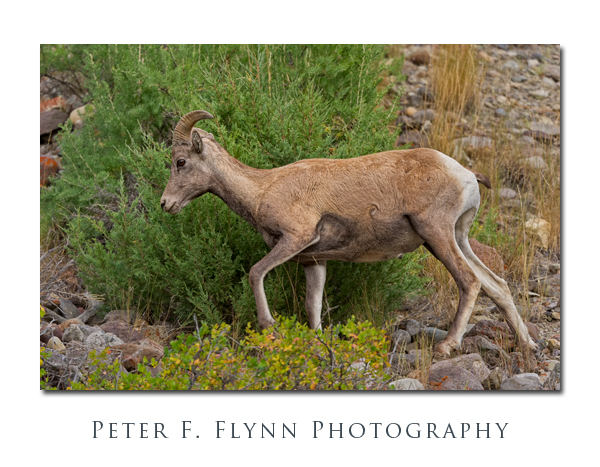
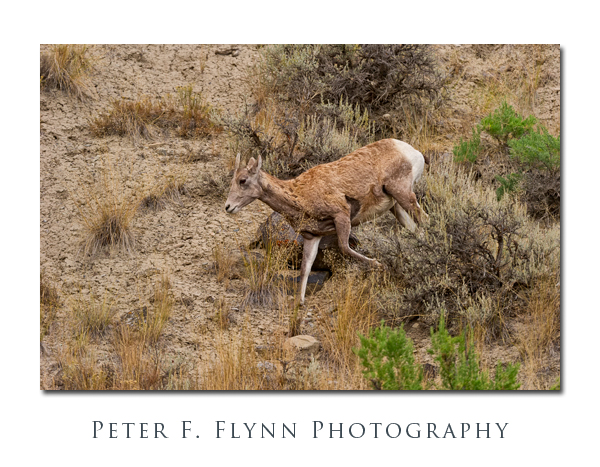
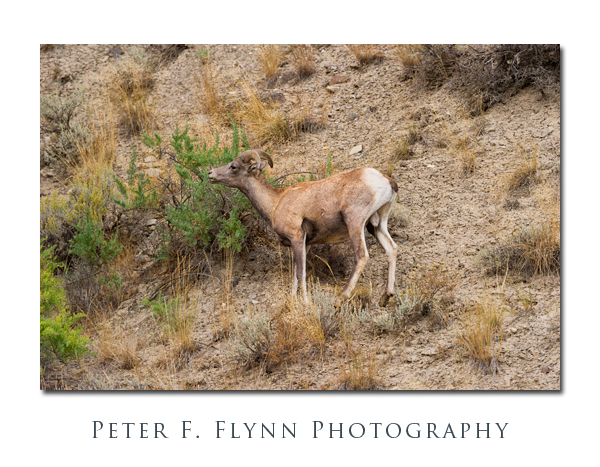
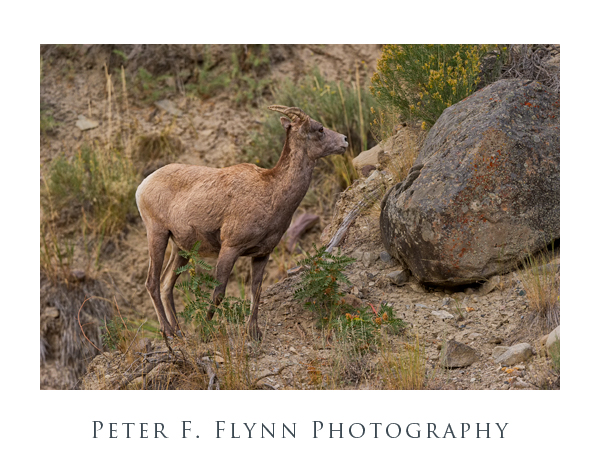
Bighorn Sheep in Gardner Canyon

Ask any YNP Park Service employee about Bighorns.  ‘Go to Gardiner’, will be their response, or perhaps ‘Go to Gardner’, but it’s the same.  Regardless, that advice is not quite definitive.  They  may mean to refer to the city on the banks of the Yellowstone River, or they may mean the river that meets the Yellowstone just north of the park entrance, or they may mean the area between the confluence and Yankee Jim Canyon…

You are in fact most likely to find Bighorns in Gardner Canyon, although they appear semi-randomly, that is, unpredictably but always in weak light. In our experience, we find that the herds that wander close to the North Entrance Road below the McMinn Bench and Eagle Nest Rock consist mostly of mature ewes and young sheep of both sexes.

If you are so lucky as to be in the Canyon when the Bighorns are there, I suggest that you shoot them at f/5.6, since you’ll need the isolation.  These clever sheep…they are almost invisible in their native environment – the little teasers…  When they do emerge, ‘excess’ DOF is not a positive contribution, since it helps them hide, well, in the image that is…

Images in this entry were recorded at around 17:00 MDT using the Nikon D3s and the AF-S NIKKOR 200-400mm f/4G ED VR II.  Exposures were all at f/5.6 and around 1/640s, ISO 3200.  Yeah, that was ISO 3200.  If you are serious about stalking the Bighorns, bring your D3s, seriously.

Images were processed to reduce noise using Nik Dfine, then capture sharpening was applied using Photokit Sharpener 2.0.  The image was then processed to enhance contrast using Nik Viveza 2 and Nik Color Efex Pro 3.

 Copyright 2011 Peter F. Flynn.  No usage permitted without prior written consent. All rights reserved.