Along the Gardner River: Bighorn Sheep!

Let’s be frank, a visit to Yellowstone National Park is really about seeing the animals*.  In a single day, it is about even-odds of viewing Bears, Bison, Elk, and Pronghorn.  Wolves and Big Horn Sheep though, are on the special list.  We’ll leave Wolves for another discussion, in this entry we’ll focus on Bighorn Sheep.

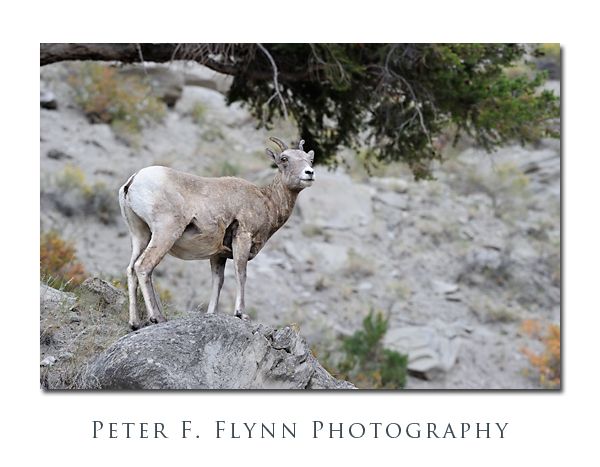
Ask any ranger where you are likely to see Bighorn Sheep, and they will most likely nominate the North Entrance Road between Mammoth Hot Springs and Gardiner, MT.  Alternatively, you might well see one or two Bighorns near the ridge above the Yellowstone River picnic area, and Yankee Jim Canyon north of Gardiner is another possibility.  Anyway, back to the North Entrance Road…  The road runs north between Mammoth and Gardiner, a distance of about 5 miles.  Two miles out of Mammoth the road joins the Gardner River**, and the road follows the Gardner until it runs into the Yellowstone River.  About halfway between Mammoth hot Springs and Gardiner (MT) the road and river pass near to steepish cliffs of Gardner Canyon.  This is the place that; if you are patient and a bit lucky, you may see a herd of Bighorns.
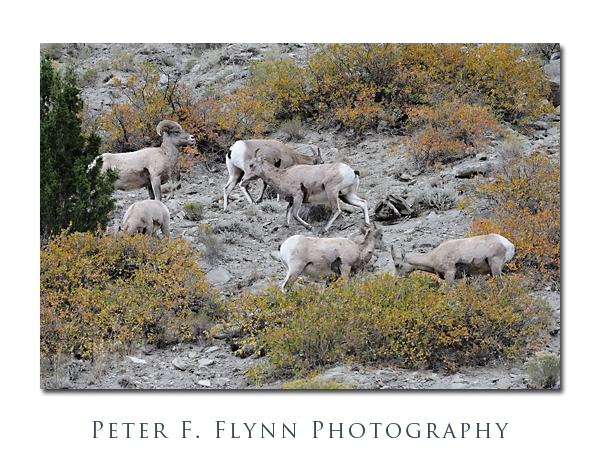
If you stalk the Bighorn from the North Entrance Road, you will naturally be shooting from below the animals – shots like the one shown below are inevitable…
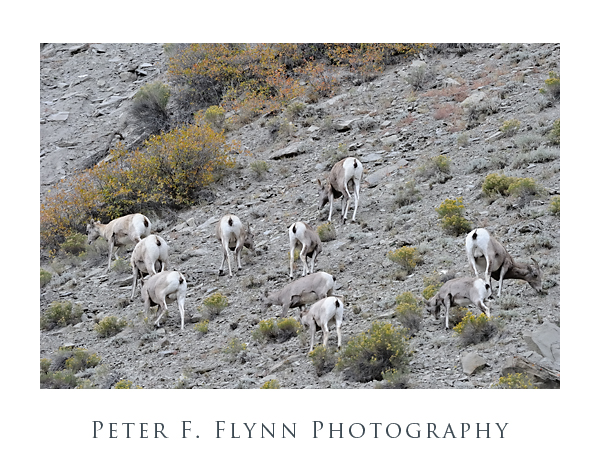
The images in this entry were recorded at about 18:00 MDT on September 22, 2010, using the Nikon D3s and the AF-S VR Zoom-NIKKOR 200-400mm f/4G IF-ED at 400mm.  Exposures were in the vicinity of f/11 and 1/400s (+0.33 EV, corrected in RAW conversion), ISO 6400. RAW conversion, noise reduction, and capture sharpening conducted using Nikon NX2.  Further processing, including contrast enhancement (curves), local contrast enhancement (USM), and output sharpening (USM) conducted using Photoshop CS5.

*Here’s a question, if not for the animals, would you visit Yellowstone?  Sure, once or twice to see the thermal works, but how often after?

**Note that the town is named Gardiner, while the river is Gardner – kinda silly.

This entry edited September 24, 2001 to convert Big Horn references to Bighorn.

Copyright 2011 Peter F. Flynn. No usage permitted without prior written consent. All rights reserved.
Happy New Year!

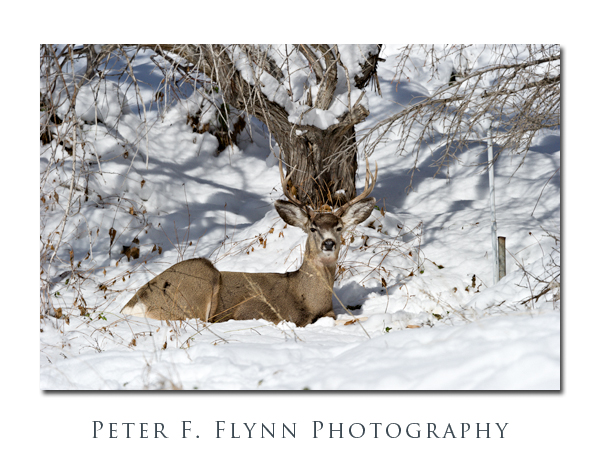
A short entry to wish everyone a very happy new year.  After a couple of days of snowy, wintry weather, today dawned mostly clear.  A pair of Mule Deer bucks decided to lounge a bit in the backyard of Casa Don Pedro, giving me a great opportunity to make the first image of the year.

The image above was recorded at about 12:30 MST on January 1, 2011, using the Nikon D3s and the AF-S VR Zoom- NIKKOR 200-400mm f/4G IF-ED lens at 400mm.  Exposure was f/8 at 1/1600s, ISO at 800.

Copyright 2010 Peter F. Flynn. No usage permitted without prior written consent. All rights reserved.
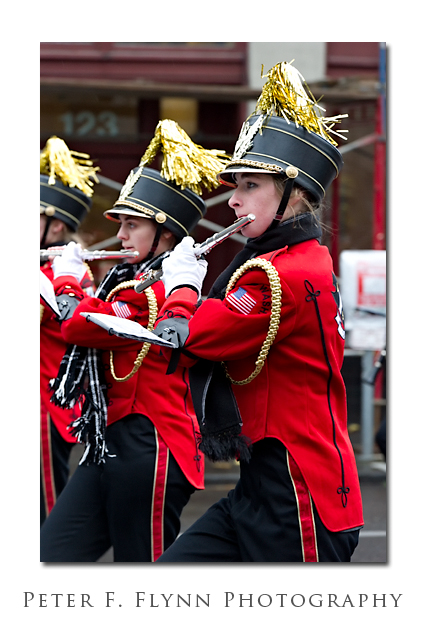
Macy’s Holiday Parade – PDX – 2010 Edition

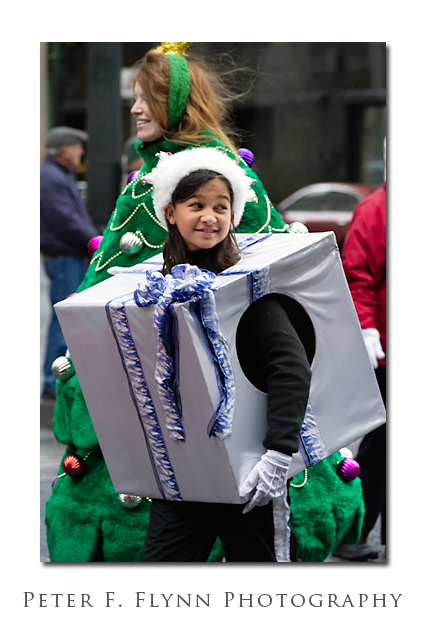
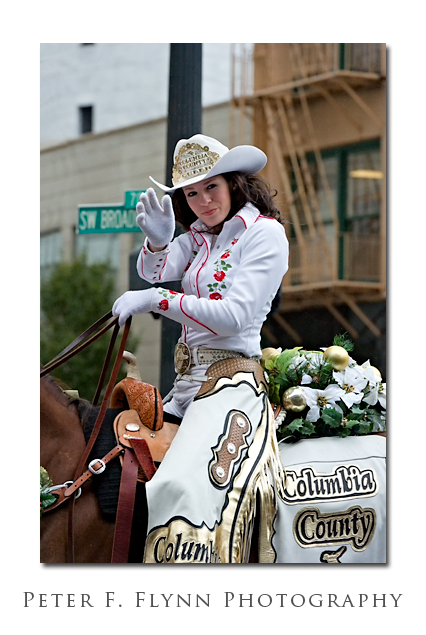
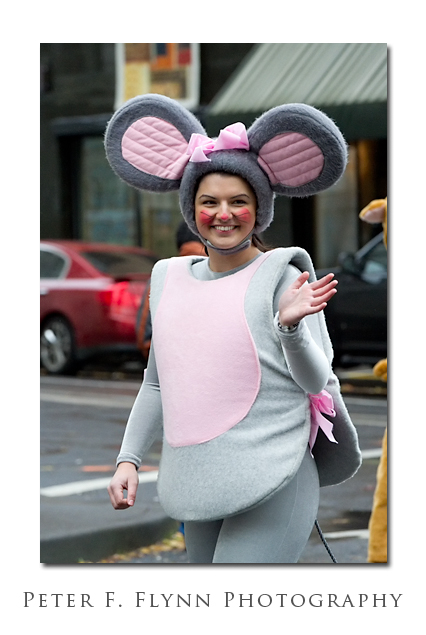
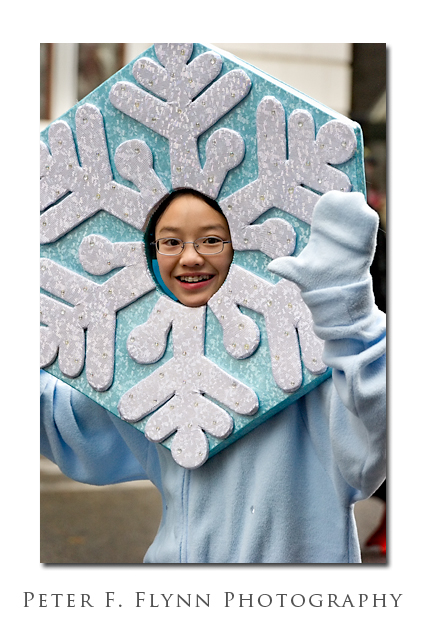
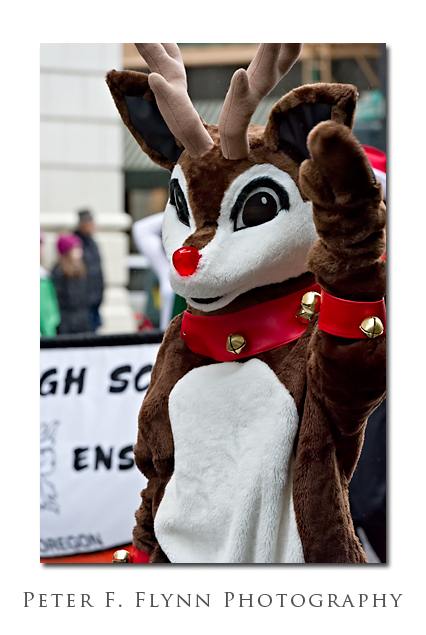
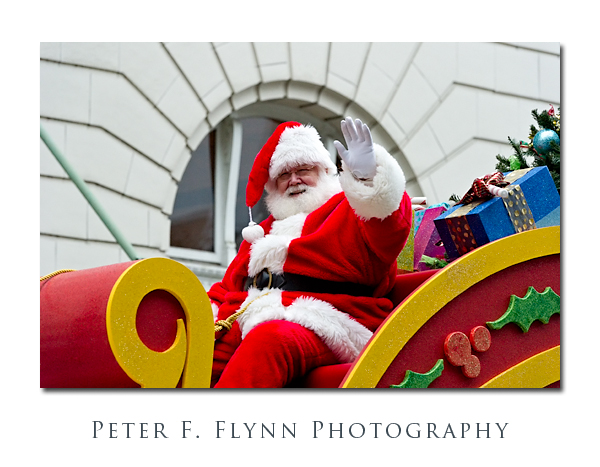
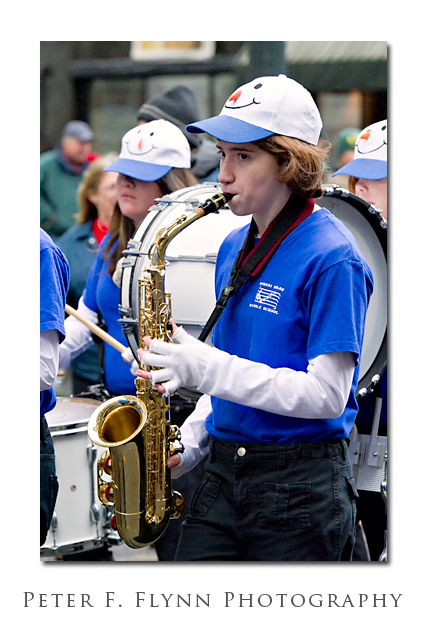
We are back at the PDX-edition of the Macy’s Holiday Parade.  My niece, Jennifer (shown above), is a killer sax player, and her band is a regular participant in the parade.  This gives me a good excuse to work in an area that I would never otherwise cover.  I don’t believe that anyone would imagine that photographing a parade would be easy, but let me just confirm that it is an extremely challenging proposition.

The main challenge of course is to get the shot right the first time – chances are that you will not get a second attempt.  This requires that you know you can properly diagnose the light, know your gear, and that you can get a wide range of shots with a minimal lens complement.  In many ways it’s the same challenge faced by any outdoor nature photographer.  If you’ve ever tried to shoot a black bear on the move or bird landing or flying off you know what I’m talking about.

Here’s a practical consideration that might be a bit under-appreciated…  Given that parades are linear entities, there are just two aspects from which to shoot them from: the left side or the right side.  How do you choose?  Of course there may be obvious advantages/disadvantages to a particular perspective, which dictate which side you choose, but often as not it’s going to be arbitrary.  For me it is easy, which side is my niece the killer sax player closest to?

Those of you who know PDX will appreciate that the street layout downtown is dominated by long boulevards that run north-south.  This geography dictates the course of the parade and means that you end up standing on either the west side; as I did last year, or on the east side as I did for this event.  Don’t even think about going back and forth – you will end up with nothing.

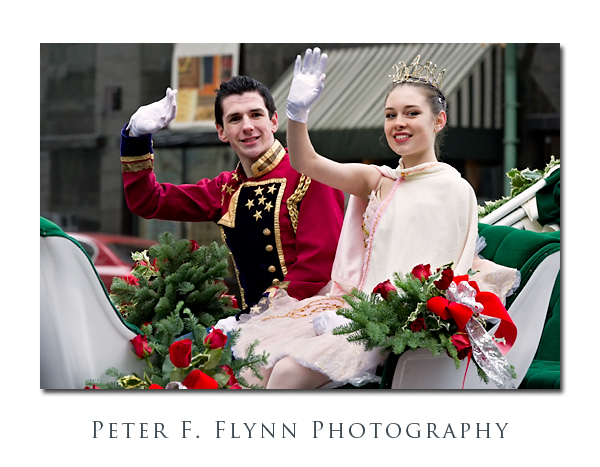
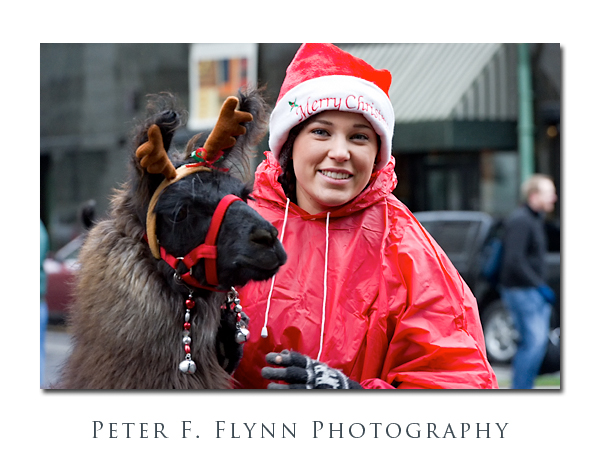
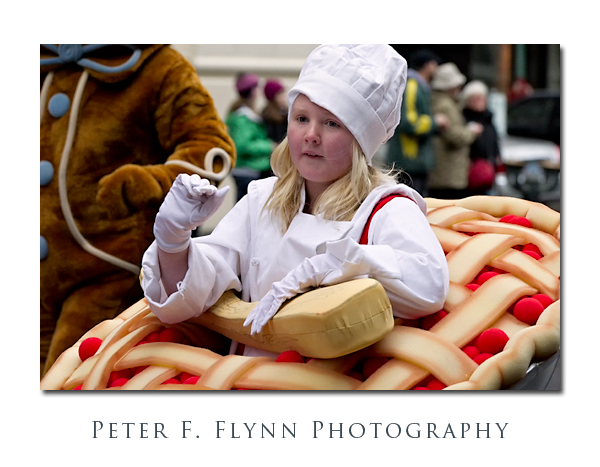
The light that morning was harsh, and I deliberately left a few shots – like the ones above of the Holiday King and Queen and the Llama handler – in the natural high-key lighting that was present.  Although I think that the high-key thing is overdone in many instances, I believe that these shots work pretty well.

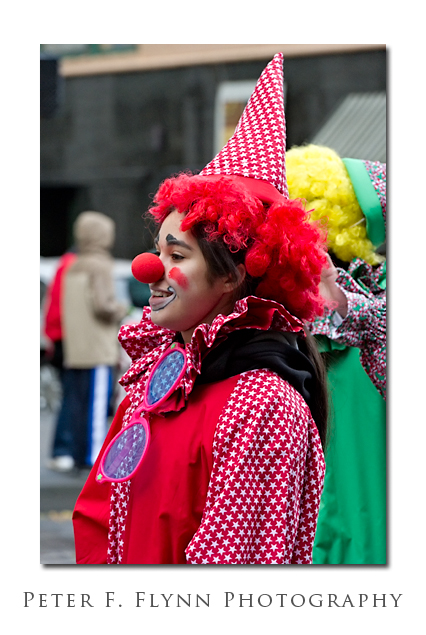
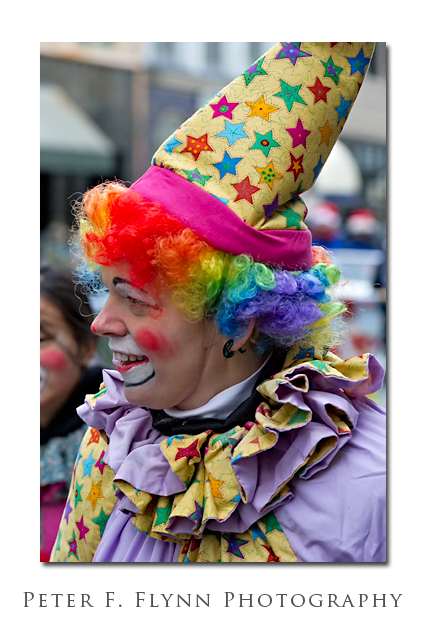
For color and contrast, what can beat a clown outfit?  Answer = nothing!

Images in this gallery were recorded between about 08:45 and 09:45 (PST) on November 26, 2010, using the Nikon D3s and the AF-S NIKKOR 70-200mm f/2.8G ED V RII lens.  Overcast sky with periodic sunbreaks led to exposures in the range of f/8 and 1/400s to 1/1000s.  ISO between 3200 and 6400 – once again, I am pretty confident that there is simply no better camera under these conditions that the D3s.

Copyright 2010 Peter F. Flynn. No usage permitted without prior written consent. All rights reserved.