Soda Butte Creek

I do not fish, but if I did, I believe I would favor the rivers of Yellowstone National Park.  If you are going to commit to standing in or on the bank of a river for hours, it seems like you might as well have some spectacular scenery to ponder.  There are many fishable streams in Yellowstone – Gallatin, Gardiner, Gibbon, Lamar, Madison, Soda Butte Creek, and of course, the Yellowstone – all of which fit the bill in terms of blending good fishing and excellent location.

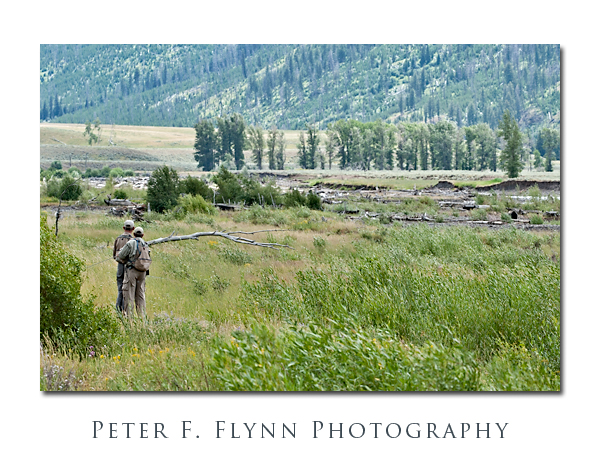
Note the two fisherman in the image above.  The location is a popular fishing spot along the Soda Butte Creek river near its confluence with the Lamar River.  They seem to be watching something pretty intently, as in, they have abandoned angling all together.  The target of their attention is actually in the shot, however the image is much too small to reveal it.  As shown below, it turns out to be a pretty good sized Grizzly Bear wandering along the bank of the Lamar river – I’d estimate that there were not more than 100 yards between bear and anglers.
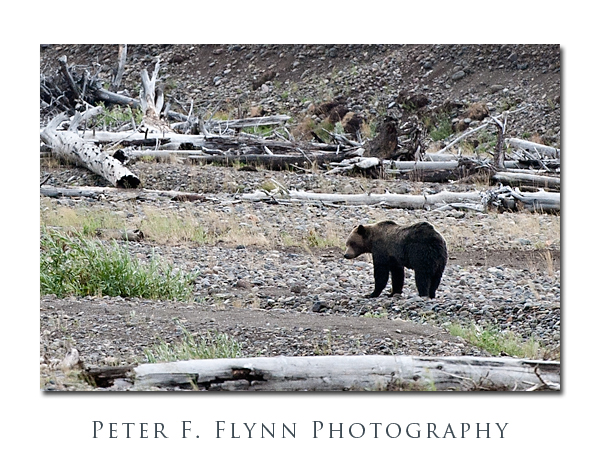
Both images were recorded from a position just north of the Northeast Entrance Road.  This spot is on the near side of Soda Butte Creek, whereas the anglers are on the far side.  The bear was foraging along the Lamar and moving rapidly, but might as easily have wandered northward into the delta between Soda Butte Creek and the Lamar – in which case the two dudes would be compelled to make a watery retreat across the Creek.

Images in this entry were recorded on August 9, 2010, at around 12:30, using the Nikon D3s and the AF-S VR Zoom-NIKKOR 200-400mm f/4G IF-ED lens at either 200mm (first image) or 400mm (second image, plus crop).  Exposure was f/8 and 1/1250s, ISO at 1600.

Copyright 2010 Peter F. Flynn. No usage permitted without prior written consent. All rights reserved.
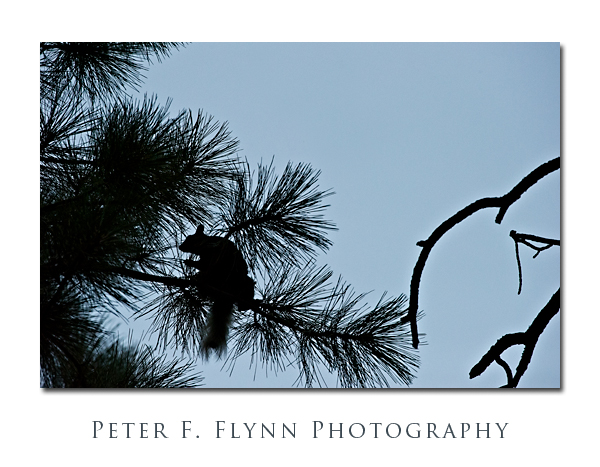
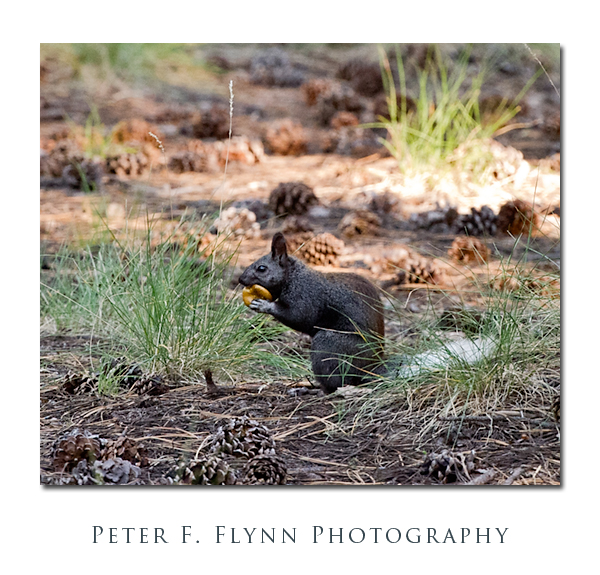
Meet Mr. Elusive: The Kaibab Squirrel

Grand Canyon, North Rim.  You will not find Sciurus aberti kaibabensis anywhere else on the planet.  Nope, you have to come here to see them, and they seem  know it…  They are beautiful animals, with tufted ears, a dark underbelly, and most remarkably, a striking bushy white tail.

Chat up any Park Service Ranger and they’ll claim that there are tons.  Lies.  If you come to photograph this unique animal, you should be prepared for the harsh truth.  There are one or two.  Okay, perhaps there are more, but it doesn’t matter, because at any particular moment, only one or two of the little buggers are scampering around the Kaibab Plateau – it’s one of the rules of their little guild.

The Kaibab Plateau is an area of approximately 800 square miles in northern Arizona in a narrow swath lying between Jacob Lake to the north and the canyon rim to the south.  The Kaibab Squirrel is cousin to the Abert’s Squirrel (thus aberti kaibabensis), which you will find in abundance in a bunch of subspecies along the south rim.  The obvious physical barrier provided the geological isolation that allowed the unique north rim subspecies to evolve.

This squirrel makes it home in the Ponderosa Pines that are common along the north rim forest, and its natural food consists for the most part of the seeds of Ponderosa pine cones and small fungi that litter the floor around the trees.  The HP and I tracked this beastie throughout our visit, but saw two specimens (or perhaps the same animal twice) – both times in the general area near the North Rim Campground.  The Campground most probably provides the squirrels with a chance to supplement their diet with more worldly fare, e.g., cheese, deli meats, crackers, bread, and so forth.

Images of the Kaibab Squirrel were recorded on August 26, 2010, using the Nikon D3s and the AF-S VR Zoom-NIKKOR 200-400mm f/4G IF-ED lens at 400mm.  Exposure was in the neighborhood of f/8 at 1/160s, ISO 8000 – yeah, I really do think you need the D3s to pull this off.

Copyright 2010 Peter F. Flynn. No usage permitted without prior written consent. All rights reserved.
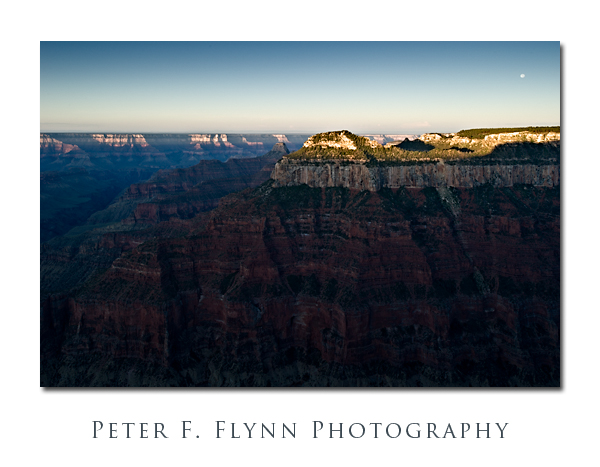
Sunrise, Bright Angel Point

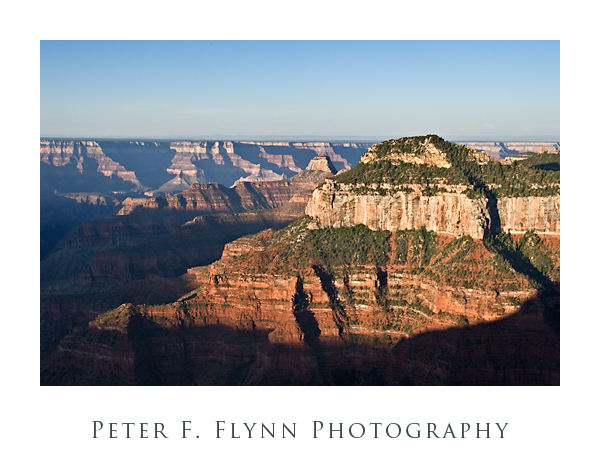
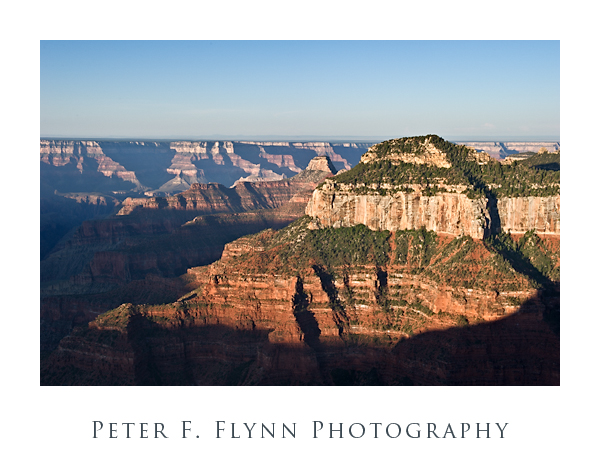
Grand Canyon, North Rim, AZ.  As you can see from the image above, it’s just another lovely day in the neighborhood.  From the Grand Lodge, the walk down to Bright Angel Point is only 0.5 mile on a paved path.  For the photographer, the challenge is to arrive at the point before the civilians arrive.  Spots like Bright Angel have a mystical/religious significance for many, and these folks naturally want to stand exactly where you want to set up your kit.  Calculate the time of the sunrise, back the alarm 1.5 hrs, and you are (probably) set.

Warning, even spouses as tolerant as the HP will challenge your sanity at this stratagem.  My advice is to suggest that since it is only a brief stroll, that you can go it solo.  Chances are that by the time you are headed for the door, said spouse will be putting on a jacket, grimly determined to keep their nutty spouse from walking sleepily off the point in search of that perfect capture.


When should you visit the north rim?  This is a question I am often asked.  The easy answer is, ‘When we’re not there’.  Sorry.  The real answer is that the monsoons in southern UT and northern AZ are a real thing, and if you can manage your schedule to dodge them – avoid the last week of July and the first two weeks of August – you are likely to have a more pleasant visit.  Also, remember that the lodge is only open between May 15 and October 15.  Be aware however, that those first and last few weeks are likely to be pretty chilly.

The images for this entry were recorded on August 25, 2010, using the Nikon D3s and the AF-S NIKKOR 24-70mm f/2.8G ED lens.

Copyright 2010 Peter F. Flynn. No usage permitted without prior written consent. All rights reserved.