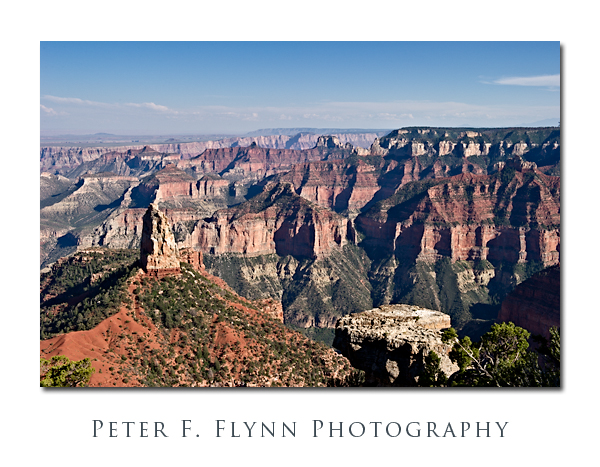
Afternoon at Point Imperial

Grand Canyon North Rim, AZ. We left SLC headed south along I15 at about 10:15 MDT.  The weather was excellent and the traffic was light.  The route to the from SLC to the North Rim is exactly the same as the route to Zion NP, until you reach the UT Highway 9 junction at La Verkin, at which point you head south to Hurricane, then dodge east along UT Highway 59.

The route continues south into Arizona along Highway 389 through Hilldale and Colorado City, and then eastward along Highway 389 to Fredonia.  BTW, Judd Auto Service in Fredonia has an excellent selection of bottled beer and general supplies.  From Fredonia, continue southeastward along Highway 89a to Jacob Lake.  From Jacob Lake the route turns south, reaching the North Rim in just over 40 miles.

For our first sortie on this visit we decided to pay an afternoon visit to Point Imperial.  This spot is excellent for photography at any time of the day, but for those with a mindset focused on the golden hours, the spot is particular attractive at dawn and the late afternoon.  Note however, that while many spots along the North Rim make excellent locations from which to capture images of the Canyon, the light here often scrams well before the golden hour.  There are several vantage points around the point.  Although the classic vista lies at the end of a short walk down to the precipice, good views; including the one shown here, may be had from the area just below (in front of) the eastern edge of the parking lot.

The image above of Mt. Hayden and was recorded on August 24, 2010, at about 17:30 MDT, using the Nikon D3s and the AF-S 24-70mm f/2.8G ED NIKKOR lens at 44mm.  Exposure was f/8.0 at 1/400s, ISO 200.  The 24-70mm is one of my favorite lenses, super sharp all-around and handles extremely well.

We really enjoy the North Rim.  It’s civilized.  A beautiful high-desert forest that runs off one of the most awesome cliffs on earth.  The place is relatively uncrowded, and since it’s in Arizona, we escape the Utah booze laws (seriously, the Utah politicos really need to stop using liquor laws an an excuse to try to better each other).  No kidding, you can grab a draft beer at The Saloon (it’s actually named The Saloon), in the Grand Lodge complex, and then wander over to the Lodge veranda which overlooks the Transept and Bright Angel Canyon.  A genuine pleasure.

Copyright 2010 Peter F. Flynn. No usage permitted without prior written consent. All rights reserved.
Albion Basin

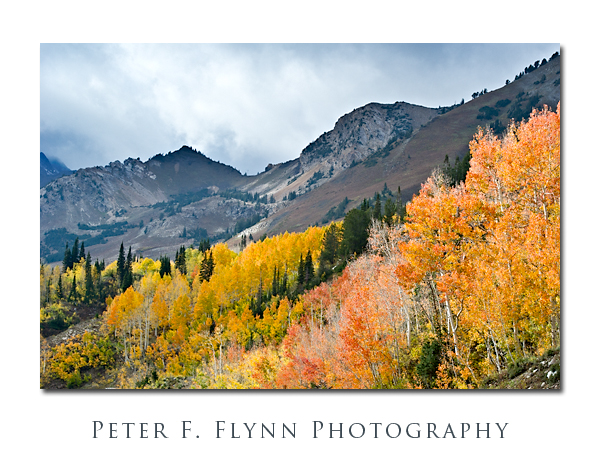
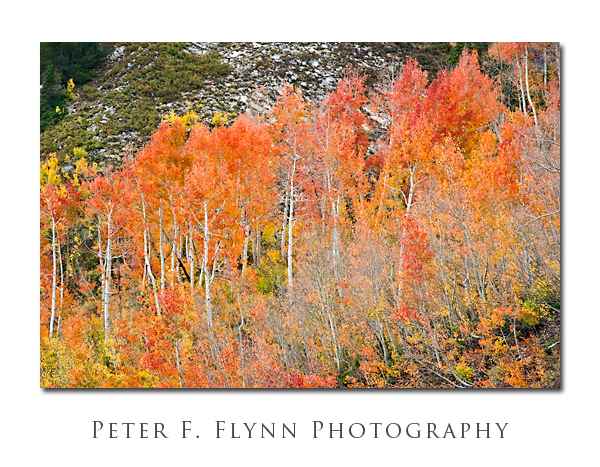
Alta, UT.  Poised in a basin formed by Mt. Wolverine to the north, Mt. Tuscarora to the northeast, Mt Sunset on the east and forming a ridge-line southeast to Sugarloaf Mountain on the southern edge, Albion Basin is a legendary hiking/skiing area.  The basin lies at road’s end, UT State Route 210, aka, East Little Cottonwood Canyon Road, just beyond the town of Alta, UT.  Beyond the hiking/skiing fame, the area is most famous for the riot of wildflowers that blooms in the spring.  The elevation of Alta is just a titch low of 9K ft, which places the basin at plus a couple of hundred ft above 9K.  Although there are not a great many trees growing altogether, the leaves on those that are here are in their prime fall splendor.  Brilliant Yellow, orange, and red, cast against the green of the pines, the gray granite, and the dark earth.

The images above were at about 13:40 MDT on Saturday, October 9, 2010, using the Nikon D3s, and the AF-S NIKKOR 70-200mm f/2.8G ED VR II lens.  The top image was recorded at 70mm, with an exposure of  f/11 and 1/1000s (to freeze the leaf movement), ISO at 1000.  The lower image was recorded at 200mm, with an exposure of f/13 and 1/200s (+0.33 EV, normalized in the RAW conversion), ISO at 1000.

A few words about the ‘new’ NIKKOR 70-200mm lens.  As good as the previous version is, and let’s be fair; it is really a fantastic piece of glass, in spite of the overemphasis on corner sharpness, the new version is a game replacement.  The optics are frankly a wash for virtually all circumstances, but for me personally the way the lens feels in-the-hand and responds have been significantly improved.

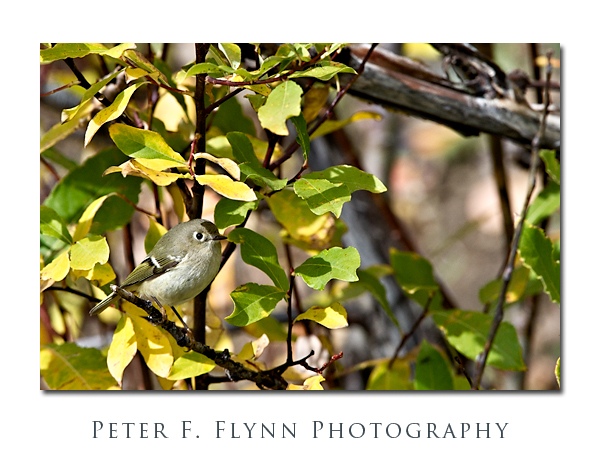
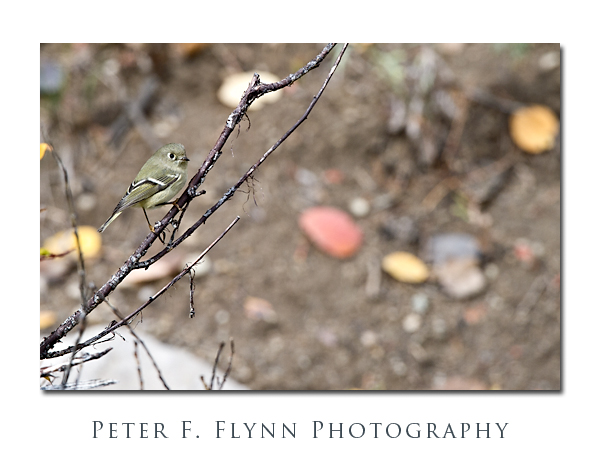
To set up for the leaf shots I (randomly) parked in front of a large bush.  Just casually looking forward I noticed a lovely smallish greenish bird keeping an eye on me.  Very photogenic thinks me, and I race around to the back of the car to mount up the AF-S VR Zoom-NIKKOR 200-400mm f/4G IF-ED lens.  These little fellows dodged in and out and all-around this big bush.  I was able to make to a few decent images of these guys during the split-seconds that they stopped moving – a great challenge and big fun.  I wasn’t able to capture an image that shows the ruby crown, but I was able to see it for small fractions of seconds as the birds fluttered around.

Images of Ruby-Crowned Kinglets, Regulus calendula, were recorded on October 9, 2010, at 15:20 MDT, using the D3s and the 200-400mm f/4 lens.  Exposure was around f/8 and 1/800s, ISO at 1000.  Thanks to Jack Skalicky and Joe Dumais for helping me get an ID on these birds.

Copyright 2010 Peter F. Flynn. No usage permitted without prior written consent. All rights reserved.
Bison bison bison

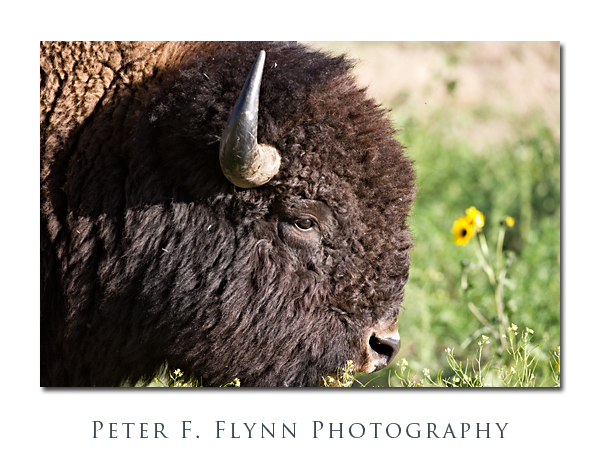
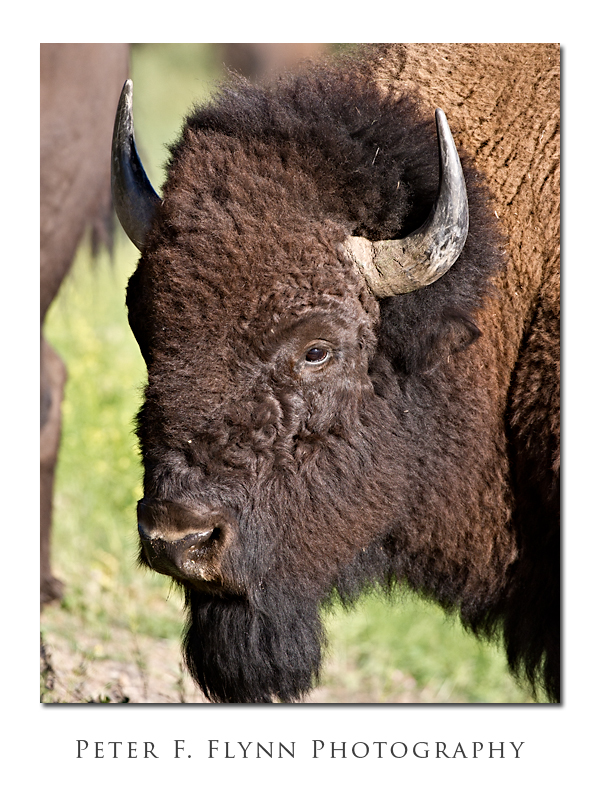
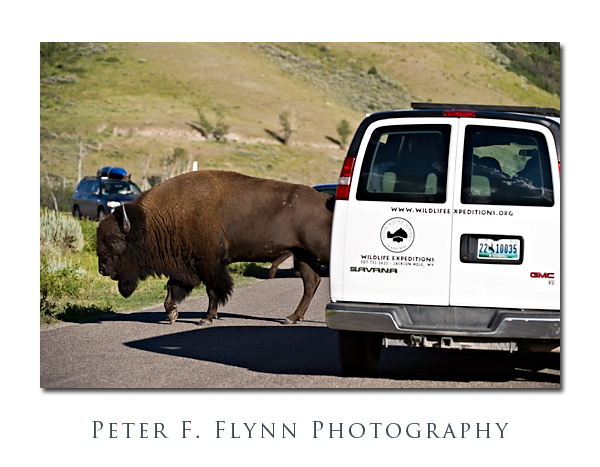
Grand Teton National Park, WY, USA.  Bison bison bison, is the American Buffalo.  To the HP and the Dude, they are the Buff or Buffs, as in ‘Watch out, there’s some Buffs in the roadway ahead there’.  They are lovely and noble beasties – and as such they make  naturally captivating photographic targets.  Bonus: they typically move relatively slowly, and moreover sort of predictably, across grassy meadows, which aids in making acceptable captures.

Grand Teton is one of our favorite Parks.  It’s a high-density experience, with transparent geological beauty and abundant wildlife all mixed together in the Teton Valley (Jackson Hole properly) – not a lot of space all-in-all.  The Bison herd that appears in this entry were photographed along the Antelope Flats Road.  Antelope Flats lies about 2 miles east of US 26/89/191 – the main north-south roadway through the park – from the junction that is north of the Moose Junction, but just south the Blacktail Pond Overlook stop.

Fortune favors the prepared.  It’s one of my many little mantras.  Stay sharp, camera ready, check exposure regularly whilst awaiting the shot.  By the way, in the Parks, or any location wherein images may be made, the HP has the wheel, and the Dude sits in the passenger front seat with the D3s and the AF-S VR Zoom-NIKKOR 200-400mm f/4G IF-ED lens.  I gotta say, I cannot imagine a better solution for capturing spontaneous events than this combo – many of the entries in this weblog have been made based on images generated using just this camera-lens combination.  It’s not a perfect solution though.  The 200-400mm is awesome up to about 100 meters, beyond, not so great, closer = better.

The images above were recorded on August 8, 2010, at between 18:00 and 19:00 MDT, using (as above) the Nikon D3s and the AF-S Zoom-NIKKOR VR 200-400mm f/4G IF-ED lens.  Exposures were f/8 (mostly) or f/5.6 (a few) at 1/1000s to 1/2500s, ISO 800.  Most of the images were recorded with the exposure pushed ‘to the right’ (of the histogram), e.g., slightly (1/3 EV) overexposed as commonly judged.  Exposures were normalized using ACR 6.1.  This in-camera-overexposure followed by normalization during RAW conversion is now a standard noise-reducing strategy.

Copyright 2010 Peter F. Flynn. No usage permitted without prior written consent. All rights reserved.