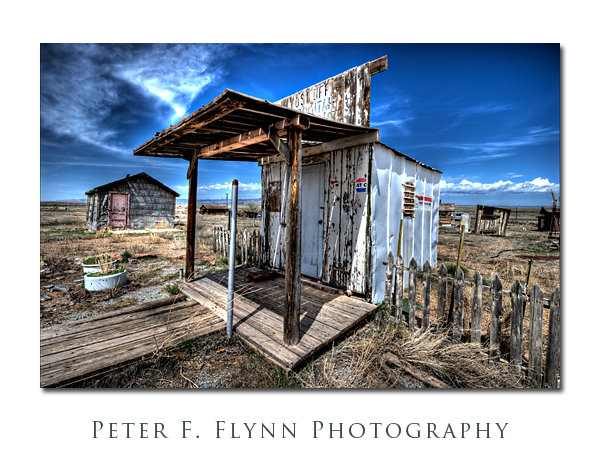
Cisco, UT 84515

Cisco, Utah, was born during the late 19th century era of the steam engine, and became an important watering stop for the locomotives.  The railroad station became a key shipping center for the livestock that were managed in the open range country of the Book Cliffs.  Unfortunately, the diesel locomotive made stops at Cisco unnecessary, and by the 1950’s the long decline of the town had began.  Unlike Greenriver, which lies adjacent to I70, and which is an important stop for travelers, Cisco was left too far off of the freeway to gain significant commercial traffic.  Hard luck.

The image above, of the old Cisco post office, was recorded on April 18, 2010 at about 12:40 MDT, using the Nikon D3s and the (new) AF-S NIKKOR 16-35mm f/4G ED VR lens at 16mm.  Exposure was f/16 and 1/160s, ISO 400.  One RAW images was converted to HDR using Photomatix 3.1 ( see below for for processing details).

Regional guides list Cisco as a ghost town.  I’m not so sure, since while it certainly does have certain attributes of a ghost town, it has also been exploited as a junk yard – plenty of character to be sure, but for ghost town aficionados it’s most probably not the real deal.  Regardless of how you define it,  the place certainly is a great location at which to refine your High Dynamic Range photography (HDR) skills.   Light, dark, decrepit structures, old, abandoned cars, it’s all in there.  The circumstance lends itself most naturally to what I will name – without any judgment – fantasy HDR.  For you HDR aficionados, by ‘fantasy’, I mean to conjure up the effect one gets with (in Photomatix language) Detail Enhancer mode tone mapping conversion.  Of course we’ve all seen this effect, and there is tons of this stuff on the web – some of it is very nice.  I include links to a few of the more active HDR sites that describe Detail Enhancer mode strategies below:

http://www.aguntherphotography.com/tutorials/raw-hdr-processing.html

http://www.stuckincustoms.com/

http://www.vanilladays.com/gallery/tag/hdr/

http://www.robertcorrell.com/

The full Detail Enhancer mode specifications for this file are shown below:

Photomatix Version 3.1
Method: Details Enhancer
Luminosity: 5
Strength: 100
ColorSaturation: 88
WhiteClip: 5.0
BlackClip: 5.0
Smoothing: High
Microcontrast: 10
Microsmoothing: 2
Gamma: 1.0
HighlightsSmoothing: 0
ShadowsSmoothing: 0
ShadowsClipping: 0
ColorTemperature: 0
SaturationHighlights: 0
SaturationShadows: 0

Copyright 2010 Peter F. Flynn. No usage permitted without prior written consent. All rights reserved.
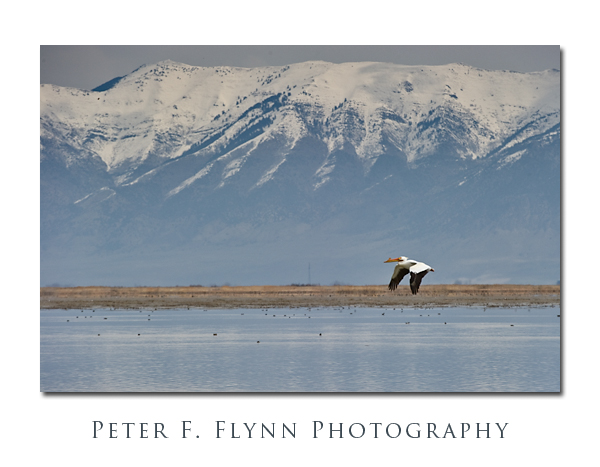
A Wonderful Bird is the Pelican

I’m not exactly certain why I think so, but to me it is just plain weird that the American White Pelican is found anywhere in Utah.  This big bird seems rigged up properly to snag some pretty big fish, and it’s just hard to see that happening near the end winter and early spring here.  California and Florida, for example, would seem to be much more natural habitats.  Nevertheless, you will quite easily find this amazing animal in Bear River Migratory Bird Refuge, as it uses the area as a nesting ground mid/late March through June/July.

The refuge is composed of three major marsh systems that are formed around the confluence of the Bear River as it enters the Great Salt Lake.  There is an excellent visitor center just a brief drive west off of I15, at exit 363 (Brigham City).  The refuge may be explored at length by driving the 12 mile auto tour route, which begins about 15 miles west of the visitor’s center.

The image above was recorded at noon on April 10, 2010, using the Nikon D3s and the AF-S Zoom-Nikkor 200-400mm f/4G ED lens at 400mm.  Exposure was f/8 and 1/2500s, ISO 640.

The refuge is not really on the way to anywhere, but it is nevertheless a compelling location for wildlife photographers and naturalists visiting the Salt Lake City area.  All in all it is a fantastical place, with a continuously rotating roster of bird species – highly recommended.

Copyright 2010 Peter F. Flynn. No usage permitted without prior written consent. All rights reserved.
Farmington Bay Blackbirds

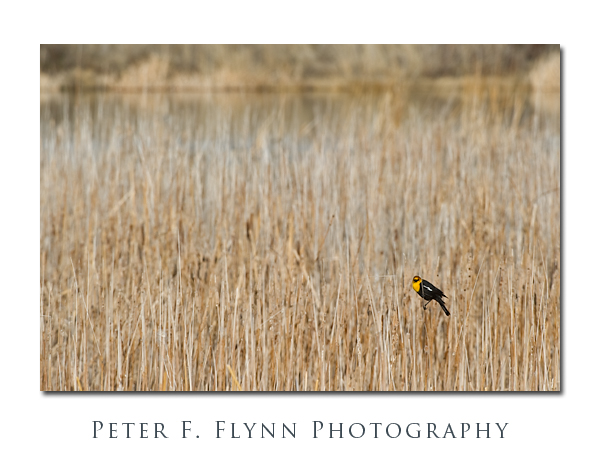
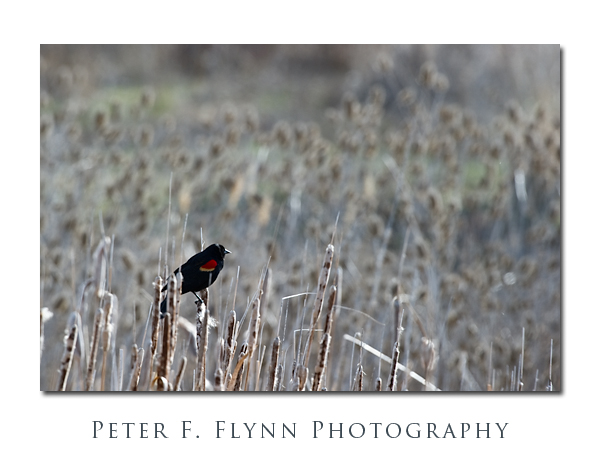
Yes, well, so I’m certain most of you expect that if we are talking blackbirds, well, we anticipate, black…birds.  Yes, and no.  Mostly black, yep, but uncolored, nope.  In fact, they are amongst the most beautiful and most entertaining birds you are likely to see in the early spring.

Male yellow-headed blackbirds (one shown above) arrive in early April sometime before the females, and flock together in groups of from just a couple to over fifty.  They are noisy and quite skittish – they will only allow themselves to be photographed at significant distance or from inside a car or blind.  The image above was recorded on April 10, 2010, at 08:30 MDT, using the Nikon D3s and the AF-S VR Zoom-Nikkor 200-400mm f/4G IF-ED lens at 400mm.  Exposure was f/8 at 1/400, ISO 200.  Image cropped.

The image below, of a red-winged blackbird, was recorded at 09:20 MDT using the D3s and the 200-400mm at 400 mm.  Exposure was f/8 at 1/400s, ISO 400.  Image cropped.

Images of both the yellow-headed and red-winged blackbirds were recorded near The Great Salt Lake Nature Center at Farmington Bay, which is about 20 minutes north of Salt Lake City, UT on I15.  Take exist 322 and drive south about 1 mile to the Glover Lane overpass and head east until you reach the parking lot for the Center.  The Center itself is adjacent to the Famington Bay Waterfowl Management Area (WMA).  Note that it is nesting season at the WMA, and access to the site is restricted to the main road, stopping at Goose Egg island and trails around the Nature Center.

Copyright 2010 Peter F. Flynn. No usage permitted without prior written consent. All rights reserved.